- About
- Topics
- Story
- Magazine
- In-Depth
- Opinion
- News
- Donate
- Signup for our newsletterOur Editors' Best Picks......Send
Read, Debate: Engage.
| topic: | Human Rights |
|---|---|
| tags: | #NBA, #New York Knicks, #Sportswashing, #Sudan, #Rapid Support Forces |
| located: | Sudan, USA |
| by: | Ithamar Handelman-Smith, Josef Reich |
As millions of New York Knicks fans celebrate their long-awaited championship, the NBA advocates social justice at home while partnering abroad with a state accused of helping fuel the world's worst humanitarian disaster. Where is the global outcry over what seems like sportswashing of a genocide?
It was bedlam on Broadway and all over Manhattan last Saturday the night of 14 June, when the New York Knicks became NBA champions again. After more than 50 years of frustration, their victory has electrified New York and delighted basketball fans around the globe, including the writer of this essay. The NBA, meanwhile, is basking in the glow of another successful season, proudly promoting itself as not just a sports league but a moral leader.
The league publicly lists equality and respect as the foundation of its operations globally. The NBA leadership has historically encouraged players to express their political and socio-political views. During recent years, the league and its players have actively used the court to promote racial equality, voting awareness, and civil rights.
That self-image deserves scrutiny.
While the NBA has positioned itself as a champion of social justice, it is also deepening ties with a country that has repeatedly been accused of helping fuel one of the world's worst humanitarian catastrophes: the war in Sudan.
In recent years, the NBA has forged an increasingly close relationship with the United Arab Emirates. Since 2022, the league has staged preseason games in Abu Dhabi under a multiyear partnership with the UAE's Department of Culture and Tourism. The NBA has opened basketball academies in the Gulf, expanded youth programs, and made the UAE a centrepiece of its international growth strategy. Abu Dhabi, for example, is no longer simply a host city; it is an important business partner.
Now one must be clear: there is nothing inherently wrong with international partnerships. The whole idea of sports is that it can build bridges, create opportunities, and connect people across countries and cultures. But partnerships can also send messages. And the message becomes more complicated, if not altogether wrong, when one considers Sudan.
For more than three years, Sudan has been engulfed in a devastating conflict between the Sudanese Armed Forces and the Rapid Support Forces (RSF), a paramilitary group that evolved from the notorious Janjaweed militias who played a significant role in the Darfur genocide that took place between 2003 and 2008, to which an estimated 200,000-400,000 people fell victim.
Since 2013, the RSF has been led by Muhammad Hamdan Dagalo, better known in his nom de guerre ‘Hemedti’, a warlord facing accusations for alleged war crimes and crimes against humanity.
The war in Sudan has devastated entire cities, and produced widespread allegations of atrocities, including massacres, ethnic violence, rapes and sexual abuse. The figures are staggering: around 14 million people have been driven from their homes in what has become the world’s largest displacement crisis, while a further 19.5 million suffer from acute food insecurity and severe hunger.
Multiple investigations and reports have raised serious questions about outside support for the RSF. According to UN experts and reporting by major international media outlets, the UAE has been accused of supplying weapons and aiding the paramilitary group, allegations the Emirati government has repeatedly denied.
Whether one believes those denials or not, the allegations are grave enough that they cannot simply be brushed aside. Yet the NBA rarely acknowledges this reality. Instead, the league celebrates Abu Dhabi as an exciting frontier for basketball—a place of gleaming arenas, luxury hotels, and lucrative opportunities.
This is precisely how sportswashing works.
Sportswashing is not necessarily about hiding controversy. It is about overwhelming it with spectacle. Governments accused of wrongdoing invest in sports because they understand something simple: fans associate athletic excellence with the institutions that sponsor it. Truth be told, the NBA is hardly alone in this. European football clubs have accepted investments from Gulf states. Formula One races across the Middle East. Golf has been transformed by Saudi money and that’s without even mentioning other major entertainment companies from the likes of Disney+ and other streaming services and media outlets with heavy ties to the UAE. Does Black Sudanese life matter at all?
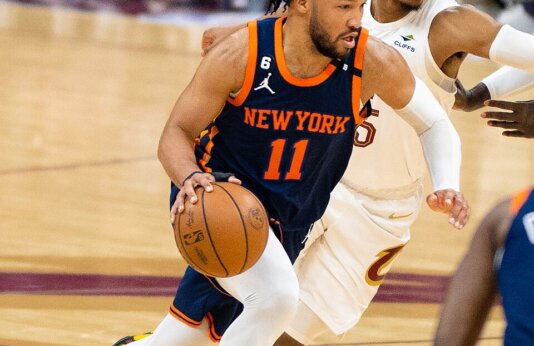
But the NBA has long insisted that it is different. It has celebrated players for speaking out against racism and injustice. It suspended business operations in Russia after the invasion of Ukraine. Its executives regularly speak about values, equality, and human rights. Jalen Brunson, the New York Knicks mega star and a personal hero of the author of these lines, is known not only for his great sportsmanship but also as an active philanthropist and advocate. His off-court efforts focus heavily on combating youth homelessness, providing nutritious meals to students, and creating educational opportunities for underprivileged youth. Can’t he see how wrong it is for him and his team to wear a patch on the upper left corner of the New York Knicks jerseys during the NBA Finals, instructing fans to ‘Experience Abu Dhabi’?
Too often ignorance is not a bliss but a curse.
As one has come to expect from a talented and charismatic speaker like him, New York Mayor Zohran Mamdani delivered a captivating victory speech. He is also well-known to raise his critical public voice, if it comes to international human-rights-violations. But - will he ever demand from the League to confront the suppression and annihilation of non-Arab and Black ethnic groups in the most troubled conflict zone on Earth?
Human rights are either universal or they are not. Engagement is a duty, when humanity is at the brink. In Sudan it is without the slightest doubt. The NBA cannot portray itself as a moral force while pretending that the political context of its business relationships does not exist. It cannot ignore uncomfortable realities.
And fans, too, should not ignore those contradictions either. I will be the first one to admit that the Knicks' championship should be a joyous moment. Their players are not responsible for Sudan's tragedy, nor are NBA fans. But the institutions that profit from global partnerships have an obligation to reckon with the consequences of those partnerships.
Sudan is being gripped by what is arguably the worst humanitarian crises of the 21st century so far. During the RSF capture of the city of El Fasher in Darfur, the mass atrocities resulted in ground discolouration and pools of blood so extensive that they were detected by satellite imagery, the first human bloodstains to have been photographed from space. And still, the world has paid very little attention.
The least we can do is to ask difficult questions about who gets to polish their image through our most beloved institutions. The NBA likes to say that basketball is bigger than the game. If that is true, then its values must be bigger than its business interests.