- About
- Topics
- Story
- Magazine
- In-Depth
- Opinion
- News
- Donate
- Signup for our newsletterOur Editors' Best Picks......Send
Read, Debate: Engage.
| November 24, 2026 | |
|---|---|
| topic: | Arts |
| tags: | #Nigeria, #education, #displacement, #Boko Haram, #Adamawa State, #community schools, #photo essay |
| located: | Nigeria |
| by: | Bankole Taiwo James |
Oscar Okaga was walking home from his farm on the edge of Yola, in north-east Nigeria, when a crowd of children in school uniform surrounded him. They came from every direction along the dusty road, so many at once that a passer-by might have feared for him. Instead, the children pulling at his sleeves were his own pupils.
‘They embarrassed me. I was just coming back from the farm,’ he says, laughing.
Those children are among the roughly 300 boys and girls enrolled at Lyntos Academy, a school Okaga and his wife, Linda, built from almost nothing in a region where almost nothing comes easily. Primary education in Nigeria is officially free and compulsory, yet the United Nations Children’s Fund (UNICEF) estimates that about 10.5 million children aged 5 to 14 are not in school. In Borno, Adamawa and Yobe states, the heart of the Boko Haram insurgency, UNICEF says 2.8 million children need emergency education support and at least 802 schools remain closed.
Lyntos began not as a policy response but in the Okagas’ own three-bedroom apartment in Adamawa State, soon after they moved there in 2020. It started with fewer than 10 children, many from nearby displacement camps. Today it has 23 staff and more than 70 pupils displaced from neighbouring Borno State.
This photo essay follows the school through the people who built it and depend on it – founders, parents and teachers – to ask what one community can achieve when the state cannot keep children in classrooms, and where that effort runs out.
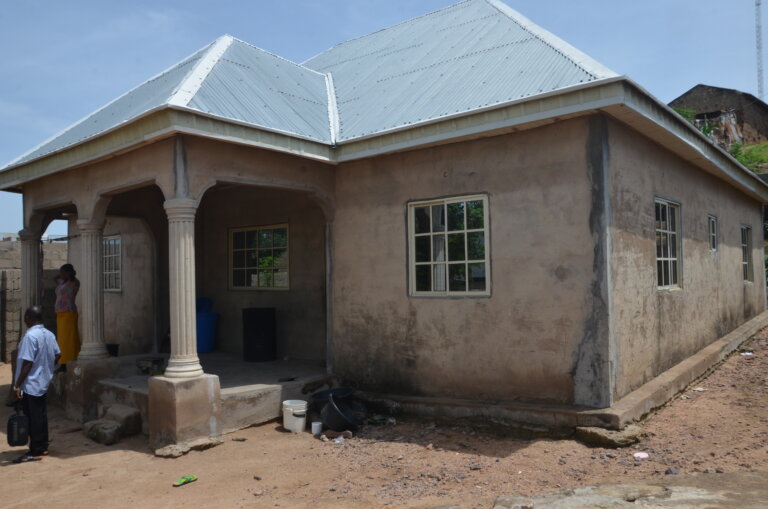
A single-storey house with a corrugated-iron roof in Yola, Adamawa State, Nigeria: the Okagas’ home, where Lyntos Academy began, 13 September 2026.
Lyntos Academy did not begin with a building programme. The couple had no money to rent premises, so their apartment itself became the school. It was an improvised beginning, but it answered a simple need: children who should have been in uniform were sitting by the roadside.
As word spread through the Fombina community, more children arrived, and the family’s own rooms were pressed into service. Their children’s bedrooms became classrooms.
‘Every day we woke up very early in the morning and cleared the children’s room,’ Linda says. The routine continued until the apartment could hold no more.
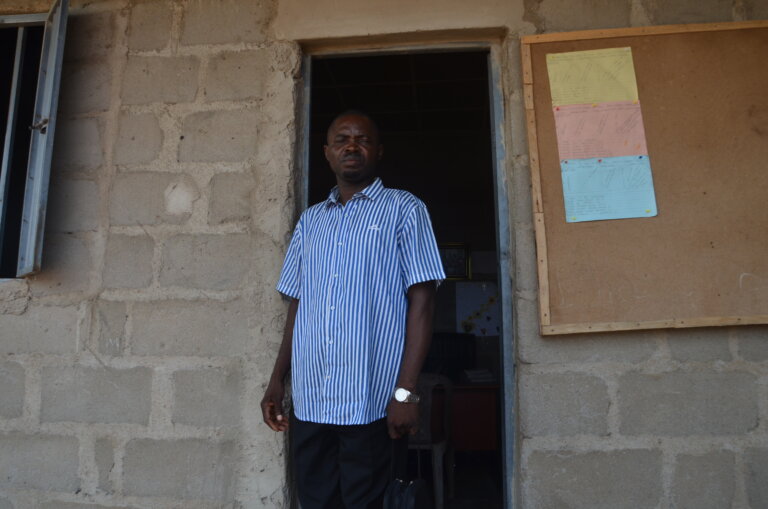
Oscar Okaga, co-founder of Lyntos Academy, stands in a doorway at the school in Yola, Adamawa State, Nigeria, 13 September 2026.
Oscar Okaga knows what displacement costs. In 2013, farmer-herder clashes in Taraba State took his family’s farmland. After years of mission work, he and Linda moved to Adamawa in 2020. In the Fombina community, they kept meeting children who should have been in uniform but sat by the roadside instead.
‘I imagine how a child wakes up, their peers are walking to school with uniforms and lunch boxes and they are just playing around, and the psychological trauma they go through,’ he says.
He still farms on the edge of Yola, and the couple’s farming income is one of the pillars that keeps the school running.

Linda Okaga, co-director of Lyntos Academy, stands in front of the school’s timetable board in Yola, Adamawa State, Nigeria, 13 September 2026.
Linda Okaga is the school’s co-director, and much of its day-to-day machinery runs through her, from tracking sponsors to coordinating staff.
The sponsors matter. Alongside the couple’s farming income and support from friends made during years of mission work, the school relies on a scheme called Adopt an Out-of-School Child, through which donors cover a pupil’s costs in exchange for updates and photographs.
About 70 of the neediest children now have sponsors. The others are absorbed anyway because, Okaga says, there is no fair way to teach one displaced child while turning another away. Sponsors’ contributions sit alongside tuition that covers only a fraction of the costs, and keeping that patchwork together is a daily job.
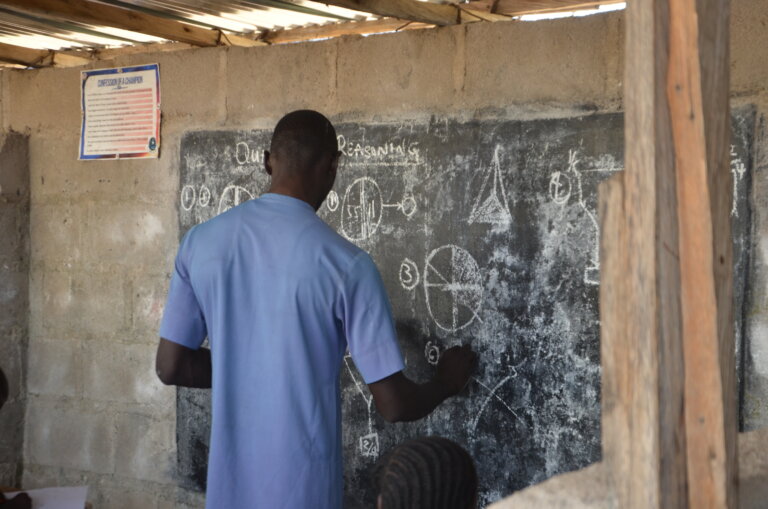 A teacher writes on the blackboard during a lesson in a block-walled classroom at Lyntos Academy, Yola, Adamawa State, Nigeria, 13 September 2026.
When the apartment could hold no more, the couple moved the school to an abandoned, roofless structure on former farmland. They roofed it with Zana grass mats and timber while parents helped clear the bush.
‘It was not funny. I became a carpenter, and … I began to do almost everything myself,’ Okaga says.
Neither founder is a builder by trade. The school’s 23 staff now teach in rooms that grew out of that improvised start. The result is not polished, but it is a school: a place where children can sit down, open a book and be counted.
 A pupil reads aloud to classmates in a classroom at Lyntos Academy, Yola, Adamawa State, Nigeria, 13 September 2026.
Roughly 300 boys and girls are enrolled at Lyntos, more than 70 of them displaced from neighbouring Borno State. Tuition is nominal by design. Families who can pay give a token 3,500 to 4,500 naira, which Okaga says covers only a fraction of the costs. Children from the camps pay nothing at all, and donors, paying parents and the founders themselves fill the gap.
Each of those pupils is a child who might otherwise be among the millions UNICEF counts as out of school. The need is wider than one school can meet. A UNICEF-backed education project notes that 56 per cent of displaced children in Borno, Adamawa and Yobe do not attend school.
 A pupil writes at a wooden desk in a classroom at Lyntos Academy, Yola, Adamawa State, Nigeria, 13 September 2026.
Many pupils arrive years behind, so the school runs catch-up classes rather than placing them in the wrong grade. Okaga hires teachers from the community, which matters in a region where, according to the same UNICEF-backed project, only 29 per cent of schools have teachers who meet the minimum qualification.
The model is simple: find the children who are out of school, take them in whether or not their families can pay, and start from where each child actually is. It depends on a small team: 23 staff for roughly 300 pupils. In practice, sponsored and unsponsored children sit side by side.
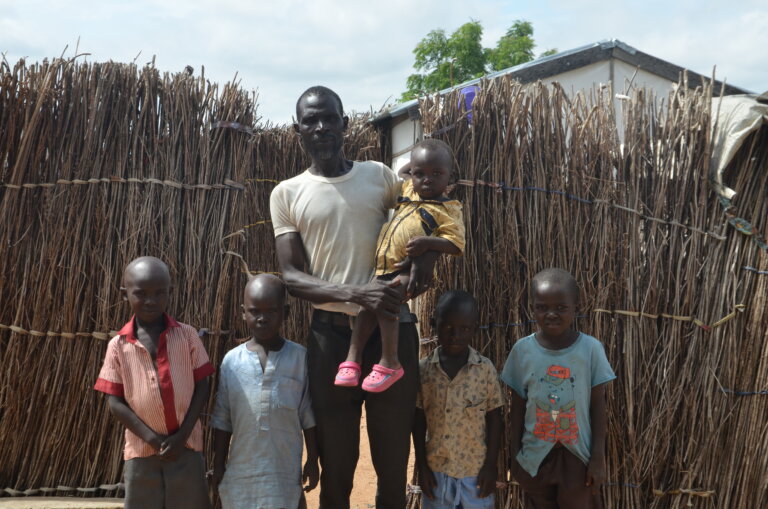 Istifanus Yohanna stands with some of his children outside their shelter in a displacement camp in Adamawa State, Nigeria, 13 September 2026.
Istifanus Yohanna lives in a displacement camp about 10 minutes’ walk from the school. He fled Gwoza, in Borno State, in 2014 when Boko Haram fighters swept through his village, eventually reaching Adamawa. The school is close enough for the children to walk there.
Seven of his 12 children live with him, and for years he could not pay for their schooling. While he was out looking for irrigation work, volunteers from Lyntos Academy enrolled all seven children.
Yohanna’s children are part of a much larger picture. In Borno, Adamawa and Yobe, UNICEF says 2.8 million children need emergency education support. Until the volunteers came, all seven of his were out of school.
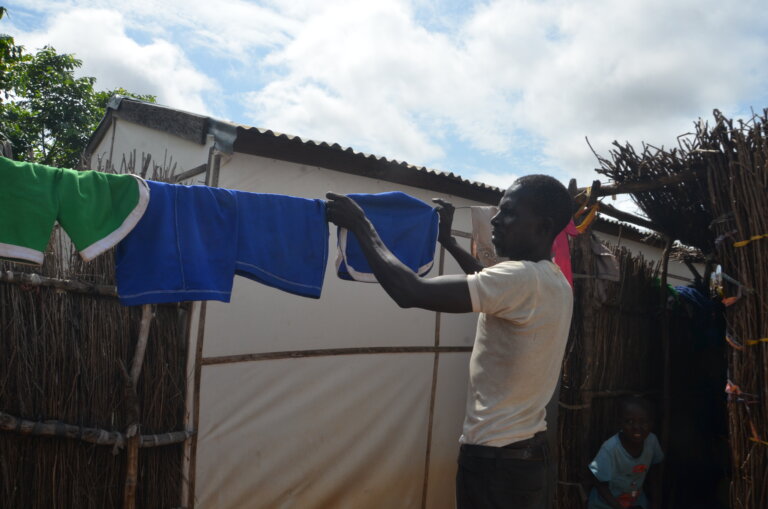 Istifanus Yohanna checks children’s clothes drying on a line outside his shelter in a displacement camp in Adamawa State, Nigeria, 13 September 2026.
‘When they told me that my children were in school for free, I was very, very happy … I even feel like they built the school for me,’ Yohanna says.
His wife now works at the school as a cleaner, a wage that matters in a household that could not afford tuition for years. It is a modest arrangement, but a stable one for now. Free schooling has lifted one burden from the family, but it has not answered every question. Yohanna still has no plan for what comes after Lyntos, because the school does not yet offer senior secondary classes.
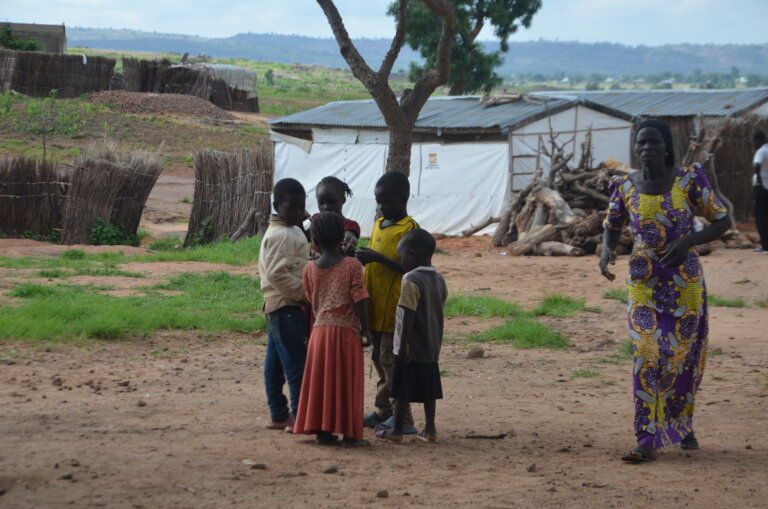 Victoria Samson stands in a displacement camp in Adamawa State, Nigeria, with children behind her, 13 September 2026.
In the same camp, Victoria Samson, a mother of eight, has lived for 11 years after fleeing an attack in Borno. Several of her children have studied at Lyntos free of charge, but three older ones finished junior secondary with nowhere to go: the school did not yet offer senior secondary classes, and she cannot afford to place them elsewhere.
‘It really makes me sad when I feel that I cannot take my children further to the senior section. I’m just praying to God to give me a way,’ she says quietly.
Her situation shows the school’s reach and its limits.
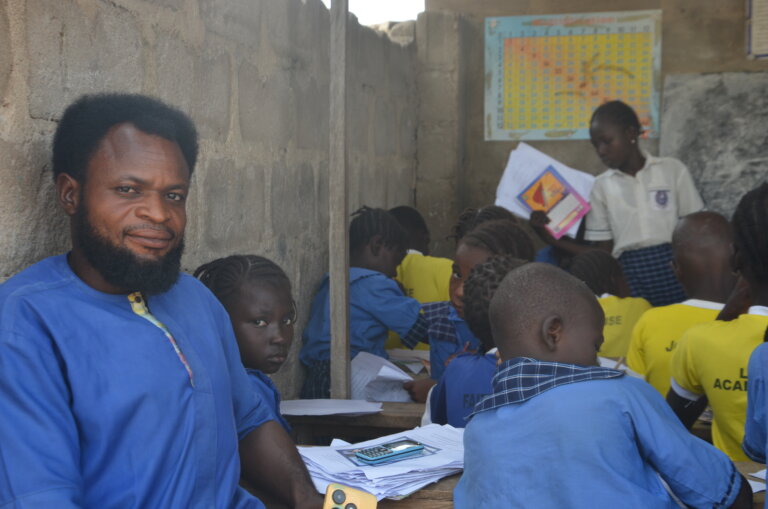
Emmanuel John Anya sits among pupils in a classroom at Lyntos Academy, Yola, Adamawa State, Nigeria, 13 September 2026.
Teachers carry much of the load. Emmanuel John Anya began gathering out-of-school children in 2018 and was soon teaching close to 50 without pay.
‘I’m not collecting any dime. I’m just doing it for free,’ he says.
Okaga, who had enrolled his own children in those classes and watched their performance improve, offered him a paid post. Anya now leads a primary-one class at Lyntos Academy.
His path shows how Lyntos finds its teachers: from the same community as its pupils, and often before it can afford to pay them. That makes payroll one of Okaga’s heaviest burdens. He speaks of sleepless nights when salaries for all 23 employees fall behind.
 A pupil in school uniform writes in her exercise book at Lyntos Academy, Yola, Adamawa State, Nigeria, 13 September 2026.
Okaga admits that literacy alone will not carry every pupil far, so the academy also teaches shoemaking, garment and bag production, and soap and cosmetics manufacturing. For children who may never reach senior secondary school, a trade is a way to earn.
‘If a child has a skill, then that’s a good one,’ he says.
The approach answers a question that Samson’s family and others like hers keep asking: what happens when the classroom ends? Lyntos does not have a complete answer, but it is trying to give each pupil something to hold on to, including those who may not reach a secondary-school place.
Lyntos Academy has not solved north-east Nigeria’s education crisis, and its founders do not claim otherwise. Responsibility for accessible, safe and adequately funded schooling for displaced children still rests with the government.
On paper, the state has not ignored the gap. The federal government launched the Safe Schools Initiative in 2014, after the Chibok abduction, and its National Plan on Financing Safe Schools sets out 144.8 billion naira for 2023 to 2026. However, AllAfrica reporting says only 15 billion naira of the 2023 allocation was released and that the programme received nothing in 2024 or 2025.
Grassroots efforts like the Okagas’ are no substitute for state investment, and they carry costs. Okaga admits that what he can offer trained graduates falls far short of what they might earn elsewhere. Parents such as Samson are left praying for a way forward, and fathers such as Yohanna have no plan beyond the next term.
But the school offers a mechanism worth studying. It finds out-of-school children, waives fees where poverty demands it, runs catch-up classes, pairs literacy with practical skills, hires teachers from the community and turns personal relationships into funding.
Back on the road outside Yola, the crowd of children now reads differently. A man mobbed by pupils was never in trouble.
‘These children are ours. Can we help them?’ Okaga says.
Image Credits: Bankole Taiwo James
 | Bankole Taiwo James Author |