- About
- Topics
- Story
- Magazine
- In-Depth
- Opinion
- News
- Donate
- Signup for our newsletterOur Editors' Best Picks......Send
Read, Debate: Engage.
| topic: | Anti-Semitism |
|---|---|
| tags: | #discrimination, #anti-semitism |
| located: | Israel, Palestine |
| by: | Ithamar Handelman-Smith |
In the aftermath of the US military operation that struck state infrastructure and captured Venezuelan President Nicolás Maduro and first lady Cilia Flores, Vice President Delcy Rodriguez almost immediately claimed Israeli involvement in the operation codenamed Operation Absolute Resolve.
‘The governments of the world are shocked that the Bolivarian Republic of Venezuela is the victim and target of an attack of this nature, which undoubtedly has Zionist undertones,’ Rodriguez said in a Saturday address in which she convened a National Defence Council. ‘It’s truly shameful.’
Rodriguez’s comments are not surprising. In the context of the Israeli-Palestinian conflict, Maduro has frequently supported the Palestinian cause in international forums. The interesting aspect of Maduro’s rhetoric is the adaptation of old antisemitic tropes to this discourse. Maduro declared in the past, on several occasions that ‘Jesus Christ was a young Palestinian’ and described him as the world’s first ‘anti-imperialist to be crucified’.
The vice president’s remarks about Zionist influence have alarmed some members of the small Venezuelan Jewish community, both within the country and abroad. Amid rising tensions between Venezuela and the US in November, Maduro had accused Zionists of trying to deliver his country to ‘the devils’.
‘There are those who want to hand this country over to the devils – you know who, right? The far-right Zionists want to hand this country over to the devils,’ Maduro said at a Bolivarian Integral Base Committee event on 15 November 2025.
‘Who will prevail? The people of [King] David, the people of God, the people of [Simón] Bolívar, or the imperialist demons?’
Maduro repeatedly emphasised that Venezuela was a Christian country, wondering why Americans would want to kill Christians, amid a US military buildup in the Caribbean and strikes on alleged drug trafficking vessels that led to operation Absolute Resolve.
‘I place at the forefront of this battle our Lord Jesus Christ, to whom our homeland has been entrusted, the only king between heaven and Earth, Jesus of Nazareth, the young child and Palestinian martyr, Jesus of Nazareth,’ Maduro said and continued by declaring that he is placing ‘Jesus of Nazareth as commander-in-chief of the battle for peace and the sovereignty of the Venezuelan people.’
Maduro did not invent the concept that Jesus was Palestinian. Jesus of Nazareth was a Jewish man born in the then Roman province of Judea (according to both historical accounts and Christian tradition). The Venezuelan president, now facing trial in the US, started voicing those ideas around the 2023 Venezuelan general elections, believed by many to be falsified and manipulated by Maduro’s party. Why then? By 2023, the campaign of ‘Jesus was a Palestinian’ was rife and it suited Maduro’s anti-Zionist and what many see as antisemitic worldview.
Indeed, one of the new claims of pro-Palestinian activists worldwide, and especially in Christian and catholic countries, is that Jesus was a Palestinian. The roots of this claim go back to Yassar Arafat and other Palestinian leaders who referred to Jesus as ‘the first Palestinian martyr’ to bolster national identity and link Palestinian suffering to the crucifixion. That claim was voiced again in an op-ed in Al-Jazeera, as well as another in the New York Times by Eric V. Copage towards the end of the last decade. The Times op-ed, titled ‘As a Black Child in Los Angeles, I Couldn’t Understand Why Jesus Had Blue Eyes’, intended to address the anachronistic depiction of Jesus as a white, blue-eyed man in Western art. However, it contained the historically inaccurate claim that Jesus was Palestinian. The Times appended a correction to the article, which clarified: ‘Because of an editing error, an earlier version of this article referred incorrectly to Jesus's background. While he lived in an area that later came to be known as Palestine, Jesus was a Jew who was born in Bethlehem.’ The sentence in the article was also revised to read: ‘But Jesus, a Jew born in Bethlehem, presumably had the complexion of a Middle Eastern man’.
Although these corrections were made by the Times, it was enough for American politician Ilhan Omar and political activist Linda Sarsour, to retweet the false claim and promote it on their high-profile social media. The vast majority of historians however, agree that Jesus was a first-century, Middle Eastern Jew. They also agree that the term ‘Palestinian’ as a national or ethnic identity did not exist during his lifetime; the name ‘Syria Palaestina’ was given to the region by the Roman Empire after a Jewish revolt in the 2nd century CE, over a century after Jesus' death.
Paula Fredriksen, a historian of ancient Christianity, made this point clear in March 2024. In the Washington Post, she called claims that Jesus was Palestinian ‘an act of cultural and political appropriation’.
Now Ilhan Omar and Linda Sarsour know that this is a false claim. After some backlash, Sarsour noted that ‘Palestinian is a nationality and Judaism a religion’, implying that there is no contradiction between Jesus being both Jewish and Palestinian. But there is a contradiction, as Jesus was a Jewish man living in Judea in a time when there was no national entity of ‘Palestine’. The damage of this campaign has been done. And it was not only Maduro who would echo those statements. This was only the beginning.
By December 2024, Pope Francis unveiled a nativity scene at the Vatican where the baby Jesus was depicted lying on a traditional Palestinian keffiyeh scarf. The scene, created by Palestinian artists from Bethlehem, generated controversy, and the specific element was later removed from the display.
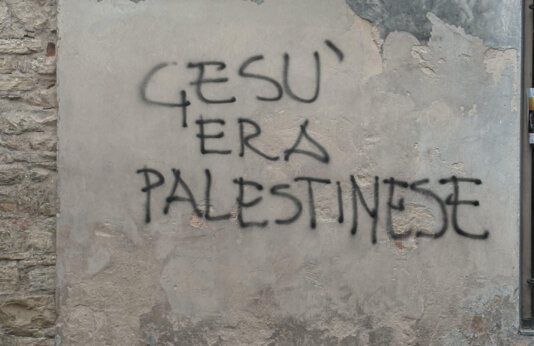
But the damage was done, and until today, this false concept is widely upheld by many. While travelling in various European countries, visitors will find graffiti stating it from Italy to Spain and from Norway to Belgium.
Why? Why does it even matter? Well, there is no better way to imply ancient antisemitic tropes (‘Jews killed Jesus’) than by claiming Jesus was Palestinian. This claim not only brings back ancient concepts that have been instrumental in the persecution of Jews throughout history, but it also brings a myth, a Biblical tone, to the current Israel-Palestine conflict. ‘Jews killed Jesus because he was Palestinian, just like they do now’; that is the subtext of this dangerous cultural and political appropriation.
These claims must come to an end. Church clergy and world leaders must put an end to this vile and orchestrated campaign and make sure that the discourse emphasises the real acute problem of Palestinian rights and the just Palestinian cause for self-determination rather than linking it with centuries-old antisemitism.