- About
- Topics
- Story
- Magazine
- In-Depth
- Picks
- Opinion
- News
- Donate
- Signup for our newsletterOur Editors' Best PicksSend
Read, Debate: Engage.
| February 09, 2026 | |
|---|---|
| topic: | Sustainable Agriculture |
| tags: | #kashhmir, #railwayproject, #awantiporatoshopian, #farmers, #byott |
| by: | Danish Showkat, Mehendi Mehraj |
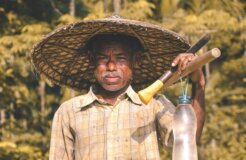
Nazir Ahmad stands at the edge of his orchard in Kunsoo village, Shopian. Speaking to FairPlanet, he keeps his eyes fixed on the ground as if the land itself has begun to slip away. An elderly farmer with a weathered face, he struggles to speak. When he does, his voice breaks-not into loud sobs, but into quiet, restrained cries that seem heavier than tears. 'I live here, and this is all I have.'
Nazir Ahmad is among dozens of orchard-owning families in Shopian and Pulwama districts whose land falls under the proposed Kakapora-Shopian railway project. The 27.6-kilometre rail link, planned between Kakapora in Pulwama and Kunsoo in Shopian, developed by Northern Railway, has sparked concern among residents who fear the large-scale loss of productive horticultural land, particularly apple orchards that form the backbone of the local economy.
Nazir owns just two kanals of land. Both fall within the alignment of the proposed Kakapora-Shopian railway project. For decades, this small patch of earth has sustained his family, yielding apples that paid for daily needs, medical expenses, and schooling. Now, marked for acquisition, it represents an uncertain future. 'I earn as a farmer,' he told FairPlanet, his hands trembling. 'If this land goes, where will I go? What will happen to us?'
He has five daughters, and the weight of responsibility sits visibly on his shoulders. 'I have to marry off my daughters. I am depressed all the time, thinking about what will happen.'
According to the Vision Document of Agriculture Production and Farmers’ welfare District Shopian, an area of 26,241 hectares is under horticulture crops with production of 3.65 lakh (365,000) metric tonnes of different kinds of fruit crops. Of the district’s total population of 2.66 lakh (266,000), around 2.58 lakh (258,000) live in rural areas and are directly or indirectly involved in cultivation. Agriculture remains the main source of income for thousands of families, supported by 33,797 hectares of cultivated land.
Raja Muzaffar, an environmental expert and activist from Pulwama district, raised concerns about deepening anxiety among local communities in a video he shared on social media on 26 December, 2025. 'The concentration of black carbon has already increased, and people are worried. If more trees are cut, the air quality will become severely poor.'
He warned that the proposed railway stretch from Kakapora to Kunsoo in Shopian could lead to the felling of nearly seven lakh trees, a loss with potentially irreversible consequences.
'This is not just about the environment,' Muzaffar said in a video statement. 'People here rely entirely on agriculture for their survival. Cutting down these trees threatens their income, their families, and the generations who have worked this land.'
A 2014 land-use analysis published in the International Journal of Scientific and Research Publications shows that Pulwama’s rural economy has undergone a steady shift over the past two decades. Between 1990 and 2010, land under horticulture more than doubled, from about 2,500 hectares to over 5,400 hectares, while land under traditional agriculture declined sharply. This expansion reflects how apple cultivation gradually replaced conventional farming as the district’s primary source of income.
Ghulam Mohi-ud-Din Mir, the MLA from Rajpora Pulwama, has urged the central government to reconsider the project. 'This will directly affect farmers whose only source of income is agriculture,' he told FairPlanet during an interview in Rajpora village, Pulwama.
'It takes hardly 20 minutes to travel from Kakapora to Shopian,' Mir said, adding that the expansion of National Highway-444 has made travel even smoother. 'When connectivity already exists, what is the need for a railway line here? It is nothing but a waste of public money.'
Mir also said that Shopian and Pulwama were earlier part of a single district and continue to function as a closely connected area. He said to FairPlanet that development should be directed towards regions that have long demanded basic connectivity. 'If there is a real need for development, it is to connect Baramulla with Kupwara by rail, to connect Rajouri and Poonch, or to build a double railway track from Katra and Jammu to Srinagar,' he said. 'By cutting through apple trees, you are taking away our bread,' Mir said.
Orchards and the Livelihoods
Aijaz Ahmad, 62, resident of Litter, Pulwama, who has spent his entire life tending to the greenhouses that line the village’s narrow lanes. For him, the proposed railway line cuts through more than land; it cuts through a life shaped by soil and seasons. Speaking to FairPlanet in Litter village in Pulwama, he said nearly 3,000 greenhouses stand to be destroyed if the track is laid through his village. 'These greenhouses grow our vegetables. This is our only source of income,' he said, his voice heavy with worry. 'We are farmers. We have been doing this work for generations.'
Official land-use data for Pulwama district indicate that more than 60 per cent of the district’s geographical area remains under cultivation.
'Around 15 families live in the small cluster of houses that fall along the proposed route. If the railway line comes, everything here will be destroyed, our homes, our work, our lives,' he said. 'We do not want this railway line. If this land is taken, where will we go after this?'
Mushtaq Ahmad, 56, a lifelong farmer from Babhara, Pulwama, stood among the fields that have sustained his family for decades, 'This isn’t just land being taken from us,' he said. 'It’s our entire livelihood. Our horticulture plots are limited, and no compensation could ever replace them.'
He spoke of the younger generation, many of whom hold post-graduate and even PhD degrees, yet have returned to the soil because jobs elsewhere are scarce. 'They came back to farming not out of choice, but necessity,' Mushtaq said. 'And now, this project threatens even that lifeline.'
Official land-use and occupational data for Pulwama district show that nearly 70 per cent of the district’s population is directly engaged in agricultural and allied activities, while only about 30 per cent depends on other occupations
For Nazir Ahmad and dozens of other farmers in Shopian and Pulwama, the fight is not against a railway line, but against losing the only life they know. The orchards they tend are not commodities; they are years of labour, inheritance, and survival bound together in living wood. An apple tree does not yield fruit overnight; it takes nearly a decade to mature, binding families to the land through patience and survival. Compensation, many farmers argue, cannot account for the loss of future harvests, ecological balance, or the dignity of living off one’s own work.
In villages along the proposed route, opposition has not died down. Farmers continue to voice their objections during official visits, insisting the track be rerouted before any irreversible damage is done.
The development has offered a glimmer of hope. During a press conference on the Railway Budget 2026, held on 2 February 2026, Union Railway Minister Ashwini Vaishnaw announced that three proposed railway projects, including the Kakapora-Shopian railway line, had been put on hold after concerns were raised about potential damage to apple orchards along the proposed alignment. He explained that the decision came in response to fears that the project could harm horticultural land. The project has not been cancelled, but its execution has been temporarily paused.
By copying the embed code below, you agree to adhere to our republishing guidelines.