- About
- Topics
- Story
- Magazine
- In-Depth
- Picks
- Opinion
- News
- Donate
- Signup for our newsletterOur Editors' Best PicksSend
Read, Debate: Engage.
| December 29, 2026 | |
|---|---|
| topic: | Human Rights |
| tags: | #abduction, ##Insecurity, #terrorism, #U.S. |
| located: | Nigeria |
| by: | Ekpali Saint |
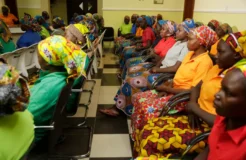
Nigeria is currently facing many security challenges, one of which is a new wave of mass abductions. In November 2025, successive abduction incidents shook the entire nation. On 17 November, gunmen abducted 25 female students from the Government Girls Comprehensive Secondary School in Maga, Kebbi State. During the attack, the group shot and killed the school’s vice principal, and left another staff member with gunshot wounds.
The next day, assailants attacked the Christ Apostolic Church in Eruku, Kwara State, killing at least two worshippers and abducting 38 others. On 21 November 2025, 315 students and staff were abducted from St. Mary’s Catholic Primary and Secondary Schools in Papiri, Niger State.
Nnamdi Chife, a defence and security expert at Chive GPS, a security intelligence company based in Lagos, said that the armed groups are exploiting the country’s weak security apparatus, and that issues such as ‘poverty, unemployment, and weak security infrastructure’ are exacerbating the security challenges.
These abductions occurred in northern Nigeria, a region that has endured decades of attacks. Although the victims kidnapped in November 2025 have been released, the recent attacks on schools have brought back memories of the tragic incident in April 2014, when 276 girls were abducted from Chibok Girls Secondary School in Borno State by Boko Haram. This Islamist militia has been waging an insurgency in the country’s north-east since 2009, alongside its splinter group, Islamic State West Africa Province (ISWAP). The insurgency has resulted in thousands of deaths and millions of people being displaced.
The abduction of the Chibok girls quickly made major headlines around the world, with prominent individuals, including Michelle Obama joining a global campaign for their release. Ten years on, some of the abductees are still missing.
Abductions are a long-standing pattern in Nigeria. Between July 2023 and June 2024 alone, SBM Intelligence – an Africa-centric security analysis and strategic consulting firm – found that at least 7,568 people were kidnapped in 1,130 cases across the country. During this period, the kidnappers demanded approximately 11 billion naira (about $7.5 million) as ransom, and received one billion naira (about $0.65 million). This is despite the fact that the Nigerian senate outlawed ransom payments to kidnappers in 2022 and made abduction punishable by death.
These days, armed groups operate confidently, even flaunting the ransom payments collected from the victims' families on social media without disguise. This display puzzles most Nigerians, who criticise the government’s inability to track and arrest the abductors through their digital footprints. In defence of the government, Daniel Bwala, President Bola Tinubu’s special adviser on policy communication, recently said that the armed groups use foreign internet services, which makes tracking their locations difficult.
‘The government's approach to negotiating with kidnappers is debated. Sure, it encourages more kidnappings, but it is also a necessary evil to save lives. A balanced approach, combining dialogue with strengthened security, will be more effective,’ Chife said. ‘The key thing is for the government to reform its internal security architecture to be able to overcome the challenges.’
Schools are soft targets for abductions. In a drastic move to prevent such incidents, the Nigerian government closed 47 of its 104 federal unity colleges across the country on 21 November 2025. These schools, however, were reopened on 18 December 2025. Some state governments also shut down private and public schools in areas where recent abductions had occurred, including Kebbi, Kwara and Niger states.
While the closure of schools effectively prevents abductions, it does not address the wider problem, nor does it constitute a long-term solution. Furthermore, Chife said that the move could undermine development and exacerbate the education crisis further in a country where over 10.5 million children are not in school – the world’s highest rate according to UNICEF.
Additionally, the closures have raised concerns and questions about the value of the Safe Schools Initiative. This initiative was launched following the abduction of the Chibok girls. Co-financed by various parties, including the Nigerian government, its primary aim is to improve the safety of students and secure school facilities across the country. However, most schools still lack even basic security infrastructure.
Prior to the recent abductions, U.S. President Donald Trump had threatened to intervene militarily in Nigeria, accusing the government of failing to prevent Islamist attacks on Christians. On 31 October 2025, Trump announced that Nigeria would be designated a Country of Particular Concern under the International Religious Freedom Act, which is given to countries engaging in or tolerating severe violations of religious freedom.
The Nigerian government rejected Washington’s claims, emphasising that people of all faiths and regions have been victims of attacks, thus criticising narratives suggesting that the country’s insecurity solely affects Christians. Nigeria is home to more than 250 ethnic groups, and Islam and Christianity are the two main religions.
‘The characterisation of Nigeria as religiously intolerant does not reflect our national reality,’ said the Nigerian president in a statement. ‘Nigeria opposes religious persecution.’
On 25 December 2025, the U.S. launched airstrikes against armed groups linked to the Islamic State (IS) in Sokoto state, in north-western Nigeria. In a post on his Truth Social Platform, Trump stated that the strikes were directed at ‘ISIS terrorist scum’ who he stated have been ‘targeting and viciously killing, primarily, innocent Christians.’
In a press release, Nigeria’s Ministry of Foreign Affairs confirmed an ongoing ‘structured security cooperation’ between Nigerian authorities and ‘international partners, including the United States of America, in addressing the persistent threat of terrorism and violent extremism.’
Although armed groups have repeatedly targeted Christian communities, available data suggest that the increase in such attacks reflects the overall increased level of violence against civilians across the country rather than being faith-specific. For example, a 2022 fact sheet by the Armed Conflict Location and Event Data Project – an independent global conflict monitor – found that, ‘violence in which Christians have been specifically targeted in relation to their religious identity accounts for only five per cent of reported civilian targeting events.’
The overall elevated threat level in Nigeria has resulted in a displacement crisis. According to the International Organisation for Migration (IOM), over 3.5 million Nigerians have been displaced internally, the majority of whom are in the country’s northern Nigeria, a predominantly Muslim region.
From insurgency to banditry, separatist agitation, abduction, and resource competition, the country’s security challenges require a comprehensive and sustained effort from the government, said Chife. To effectively tackle insecurity in the country, he added, the Nigerian government must establish a state policing system and introduce technological tools such as drones for intelligence gathering. According to Chife, the government must further set up ‘rapid-response teams’ to coordinate operations.
‘Addressing insecurity requires a multifaceted approach. I think Nigeria may benefit from foreign support, but it is very important to ensure that any assistance complements national efforts and respects sovereignty so as not to deepen domestic crises,’ Chife said, adding that Nigeria should prioritise building its security capabilities while engaging ‘in strategic partnerships’.
 | Ekpali Saint Author |
By copying the embed code below, you agree to adhere to our republishing guidelines.