- About
- Topics
- Story
- Magazine
- In-Depth
- Picks
- Opinion
- News
- Donate
- Signup for our newsletterOur Editors' Best PicksSend
Read, Debate: Engage.
| topic: | Human Rights |
|---|---|
| located: | Syria |
| by: | Ronya Othmann |
Writing this text feels almost impossible to me. Every hour, new reports reach me, some of them contradictory. Much of it is nearly impossible to verify from afar, and once you have verified one piece of information, the next report is already arriving.
So, what happened? At the beginning of January, units of the 'Syrian Army' attacked the predominantly Kurdish neighbourhoods of Ashrafiye and Sheikh Maqsoud in Aleppo. Although 'Syrian Army' is somewhat misleading, because what is referred to as the 'Syrian Army' consists of jihadist militias, namely the Turkish-backed SNA and HTS, formerly the al-Nusra Front, formerly al-Qaeda, which have been incorporated into this 'Syrian Army.' In early January, these forces attacked the Kurdish districts of Aleppo and committed atrocities. More than 150,000 people fled. Fighting continued for days with the Syrian Democratic Forces (SDF). The SDF are the Kurdish-led forces that control northeastern Syria, also known as Rojava. Eventually, a ceasefire was agreed upon. The Autonomous Administration of North and East Syria completely withdrew from the Kurdish neighborhoods of Aleppo.
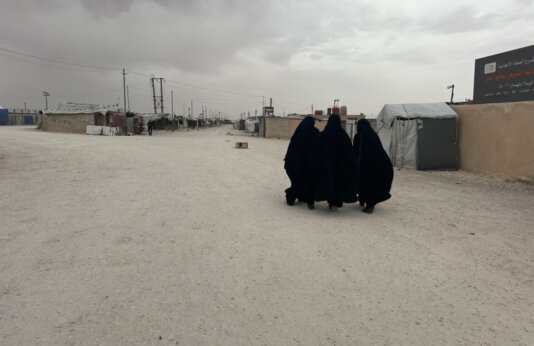
However, the ceasefire did not hold. The 'Syrian Army' advanced eastward. Deir Hafir was taken, as were the Tabqa Dam on the Euphrates, Raqqa, and Deir Ezzor. Golani’s men freed ISIS terrorists from prisons. Eventually, the SDF also lost control over the al-Hol detention camp, where tens of thousands of ISIS supporters and their families had been held. This poses a danger not only to the region, but also to Europe. And it is a mockery of all the victims of ISIS, of the Yazidi survivors who to this day have not seen justice for what was done to them, and who must now watch as the perpetrators flee, jubilant.
The advances of the 'Syrian Army' were accompanied by reports of war crimes. In a written statement, called on mosques across the country to celebrate the 'conquests and victories' over the SDF in the east of the country. The letter opened with the Surah al-Anfal, the eighth chapter of the Quran. This is no coincidence. It is the same surah that gave its name to the Anfal Operation, Saddam Hussein’s genocidal campaign against the Kurds, in which more than 150,000 Kurds were murdered. Kobane, the city that was retaken from ISIS in 2015, is currently still encircled by units of the 'Syrian Army.'
How this will now continue is uncertain. The Kurds have announced that they will not lay down their weapons and will resist. They do not want to live under Islamist rule. And Islamist it is, this 'Syrian transitional government'. One should probably say regime, because this 'government' has not been confirmed by any democratic election. The self-proclaimed Syrian president Golani may have put on a suit, trimmed his beard, and resumed using his civilian name, Ahmed al-Sharaa, but he has not distanced himself from Islamism. Once a member of al-Qaeda, the Islamic State of Iraq, commander of the al-Nusra Front and HTS, he said during a visit to New York in the autumn, at an event with the Syrian community, that he was proud of his past and did not regret any phase he had gone through. His actions over the past thirteen months, since he moved into Assad’s former presidential palace, do not indicate any departure from Islamism either. Nothing has been done to curb the rampant incitement against minorities, especially Alawites, Druze and Kurds. In March, men under his command, official units of the 'Syrian Army,' carried out massacres against the Alawite population on the coast. In July, massacres followed against Druze and Christians in Suwaida. And the days, weeks, and months before, between, and after are marked by countless human rights violations.
What is certain: In the past thirteen months, Golani has not brought security, stability, or peace to Syria, but quite the opposite: massacres, displacement, terror.
It is also certain that under Islamist rule, there can be no future for minorities in Syria.
It is impossible to say how many Yazidis still live in Syria today. Before 2011, there were said to be around 15,000. Many have long since left the country, including large parts of my own family. They fled not only from ISIS, but also from Golani’s men. And these men have not only been wreaking havoc in Syria since last year. As early as 2013, they attacked Yazidi villages, looting and killing. Not only Yazidi villages, but also Druze, Alawite, Christian, and Kurdish ones.
The few Yazidis who remain in Syria are primarily in the territory of the Autonomous Administration of North and East Syria, in Rojava. Although Rojava has for years been under attack by Turkey and Islamist militias, Yazidis are comparatively safe there. They can practice their religion freely, something they were not allowed to do under Assad. There is gender equality. The administration, the security forces, and the schools, are secular.
Should Golani truly take control of Rojava, it would mean the end of Yazidi life in Syria. Of that, there is no doubt. The last Yazidis who have endured there or sought refuge in recent years would then try to leave the country. And this end would have been sealed with the help of the EU and the United States, who have effectively legitimised this Islamist terrorist as the Syrian president. Not only did it legitimise him, but actively supported him. Ten days ago, during her visit to Damascus, European Commission President Ursula von der Leyen pledged 620 million euros in reconstruction aid to Golani. The German Chancellor Friedrich Merz has also invited Golani to Berlin. He has not withdrawn this invitation, even after the events of the past days.
As I finish this text, more messages, images, and calls for help are reaching me. The people of northeastern Syria, of Rojava, are standing at the edge of an abyss. Will the world allow them to be pushed over it?
Ronya Othmann is a German-Kurdish writer and journalist. She is a columnist for the Frankfurter Allgemeine Sonntagszeitung and the award-winning author of several books exploring themes of identity, memory, and political violence, with a particular focus on the Kurdish-Yazidi experience.
Image by Ronya Othmann