- About
- Topics
- Story
- Magazine
- In-Depth
- Opinion
- News
- Donate
- Signup for our newsletterOur Editors' Best Picks......Send
Read, Debate: Engage.
| March 30, 2026 | |
|---|---|
| topic: | Freedom of Expression |
| tags: | #Kashmir, #Iran, #US-Israel Iran war, #Ali Khamenei |
| located: | India, Iran |
| by: | Numan Bhat |
On the morning of 1 March 2026, the usually crowded lanes of Srinagar’s old city fell into an unusual quiet. Overnight, reports had spread rapidly across social media and messaging platforms claiming that Iran’s Supreme Leader, Ali Khamenei, had been killed in a strike amid escalating tensions in West Asia.
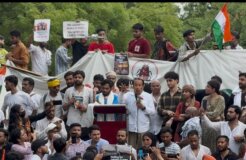
The news moved quickly from phone screens to everyday conversations. By early morning, it had reached homes, mosques, and marketplaces across the Kashmir Valley. For many residents, the first reaction was disbelief. Others described a sense of shock, followed by confusion. Within hours, small groups began forming outside mosques after Fajr (early morning) prayers in parts of Srinagar, Budgam, and Bandipora. In some areas, protests broke out. Protesters raised slogans like "Down, down America," along with anti-Israel chants. Some also shouted "Long live Khamenei" and "We stand with Khamenei." In other places, residents gathered in silence, discussing the reports and questioning their authenticity.
The strong reaction in parts of the Valley is rooted in long-standing religious and cultural connections with the Shia Muslim world. Areas such as Zadibal in Srinagar and several parts of Budgam have significant Shia populations, where Iranian leadership has historically carried symbolic religious importance. For many, figures like Ali Khamenei are seen not only as political authorities but also as religious guides.
‘I heard the news in the morning while opening my shop… and I just stopped for a moment, dil sach mein hil gaya (it really shook me),’ said Abbas Naqvi, a shopkeeper from Zadibal. ‘For a few minutes, I didn’t even know what to do. Outside, people had already started gathering in small groups, just talking, asking each other what actually happened. No one really had clear answers.’
In Budgam, similar scenes were reported, though the tone varied from place to place. ‘People were mourning loudly… it was hard to even stand there. I couldn’t hold myself either, main bhi ro pada (I also broke down),’ said Ali Mehdi. ‘It just felt unreal… I saw grown men in tears, some just sitting quietly with their heads down… kisi ko samajh nahi aa raha tha kya kahen (no one knew what to say). The whole atmosphere felt heavy, like something inside everyone had just gone silent.’ For these communities, the response was shaped by a sense of religious connection that extends beyond national boundaries. A similar pattern had been observed in 2020 following the killing of Iranian military commander Qassem Soleimani, when protests were reported in several parts of Kashmir.
However, the reaction this time was far from uniform. Alongside expressions of grief and solidarity with the Islamic Republic, there were also voices often less visible in public spaces that offered strong criticism of Iran’s leadership and questioned the narrative surrounding it.
Dr Umer Bashir, a Kashmiri based in Delhi, told FairPlanet during a phone call that any coverage focusing only on emotional responses would be incomplete. ‘Ali Khamenei has been a deeply controversial figure, especially inside Iran. There have been repeated protests over the years, many led by young people and women. These protests were not minor — they were widespread and often met with force. That reality must be part of the conversation,’ he said.
His remarks point to a broader context often missing from surface-level reactions. In recent years, Iran has witnessed multiple waves of protests, including those triggered by economic grievances, political restrictions, and social issues. Demonstrations such as the 2022 protests following the death of Mahsa Amini drew global attention, with widespread allegations of crackdowns and human rights violations.
Another student, Aamir Yaqoob from Aligarh Muslim University, said discussions among young people in India are increasingly shaped by access to global information. ‘We are not limited to one narrative anymore. When something like this happens, people look at different sources. They know there are serious allegations against the system in Iran about restrictions, arrests, and suppression.’
Criticism also extends to the role of the Islamic Revolutionary Guard Corps (IRGC), a powerful institution within Iran that has significant influence over both domestic and regional affairs. While supporters view it as a protector of the country, critics both within Iran and internationally have accused it of playing a key role in suppressing dissent and shaping controversial foreign policies. The IRGC has also been designated as a terrorist organisation by several countries, including the United States, the EU, Canada, Saudi Arabia, and Bahrain, among others.
Neha Sharma, a researcher based in Delhi, said on March 11, during an interview with FairPlanet, that the role of such institutions creates an incomplete picture. ‘When we talk about leadership in Iran, we cannot separate it from the structures that sustain it. The IRGC is central to that system. There are well-documented concerns globally about its role in internal repression and regional conflicts. These factors influence how people interpret any major development related to Iran,’ she said.
People outside Iran often see the leader as a symbol of resistance against the West or a religious authority, something ideological or geopolitical. But many people inside Iran see it differently as part of a political system they have been protesting against for years, due to repression, economic issues, or lack of freedoms.
Among the most revealing perspectives came from Iranian students studying in India, some of whom described a stark contrast between how events are perceived abroad and how they are experienced within Iran.
Abbas Karimi, an Iranian who travelled to India for medical treatment and is now unable to return, said the reports have left him deeply shaken and emotionally drained. Sitting far from home, he described a constant sense of anxiety. ‘At a time like this, being away from your family is very painful. You keep thinking about their safety and what they might be going through,’ he said.
Reflecting on the reactions, he added, ‘For many outside Iran, this is about a leader who represents resistance or religious authority. But for many inside Iran, it is about a system that has been challenged for years. This is a moment filled with mixed reactions’ he told FairPlanet.
Another student, Leila Hosseini, told FairPlanet that international reactions often overlook everyday realities. ‘There are people in Iran who have protested for basic freedoms, and some have faced serious consequences. Moments like this don’t produce a single reaction; people interpret them through their own experiences and expectations,’ she said.
Faisal Mir (name changed), a businessman from Srinagar, said there is a noticeable gap between public expression and private opinion. ‘Privately, people discuss many things. They talk about protests in Iran, about how dissent is handled there. Not everyone supports everything, but not everyone feels comfortable saying that openly,’ he said.
People may hold back because of fear of judgment from others, trying to avoid arguments or tension, or feel it is safer to keep their opinions private. In sensitive political matters, many prefer to discuss things quietly rather than express views in public.
Dr Irfan Hashim, a media analyst, told FairPlanet that the surge of online content related to developments in Iran requires scrutiny. ‘In today’s media environment, unverified information can spread very quickly and trigger real-world reactions. That is why it is important to verify facts before concluding. Otherwise, it can lead to confusion and unnecessary tension,’ he said.
His remarks come amid a wave of conflicting and often misleading reports about Iran’s leadership, including viral claims that Supreme Leader Ayatollah Ali Khamenei was ‘alive’ or had reappeared after being declared dead. Several such videos and posts were later debunked as old footage or misrepresented content, highlighting how quickly unverified information can shape public perception.
Similarly, Sana Qayoom (name changed), a postgraduate student from Baramulla, told FairPlanet during an in-person conversation in Baramulla that younger generations are increasingly questioning established narratives. ‘We grew up hearing one side, but now we have access to much more information. We see videos, reports, and accounts from inside Iran that change how we think.’
 | Numan Bhat Author |
By copying the embed code below, you agree to adhere to our republishing guidelines.