- About
- Topics
- Story
- Magazine
- In-Depth
- Opinion
- News
- Donate
- Signup for our newsletterOur Editors' Best Picks......Send
Read, Debate: Engage.
| October 02, 2026 | |
|---|---|
| topic: | Natural disaster |
| tags: | #Venezuela, #Latin America, #Essay, #natural catastrophe, #humanitarian aid |
| located: | Venezuela |
| by: | Gabriela Mesones Rojo |
‘It’s gone. It’s all gone.’
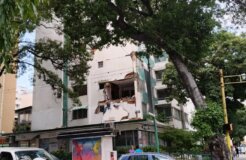
That is what my father told me a few days after the earthquake, when authorities finally allowed him to see what remained of his building. He had lived there for twenty years. The building had collapsed, and none of our neighbors survived.
But he wasn’t talking only about concrete. He was talking about a community, familiar faces and decades of shared lives buried beneath the rubble.
Like him, thousands lost homes, jobs and family members. The first days blurred into rescue efforts, government response and the constant search for news of those still missing.
And then, slowly, the rescuers left, the cameras moved on, and the emergency became everyday life.
Three months ago, at 6:04 p.m., the lives of millions of Venezuelans changed forever.
On June 24, two powerful earthquakes, measuring 7.2 and 7.5 in magnitude, struck just 39 seconds apart. In little more than two minutes, Venezuela’s northern coast was transformed. Across six states, buildings collapsed or were damaged beyond repair, reshaping more than a dozen cities. The International Organization for Migration (IOM) estimates that almost 7 million people were directly affected.
But nowhere was the destruction more overwhelming than in La Guaira, where entire neighbourhoods disappeared, and the scale of the humanitarian crisis became impossible to ignore. So far, the official death toll stands at just under seven thousand and UNHCR states that 18,000 remain without shelter.
For Venezuelans, La Guaira is more than a place on the map. Located 40 minutes from Caracas, the city is the country’s historic gateway to the Caribbean, a place of childhood holidays, family gatherings, music, fishermen and markets. It is also home to Venezuela’s international airport, the first place many migrants see when they return home. Today, much of that landscape has been erased.
Collapsed buildings have altered the city so profoundly that people struggle to navigate neighbourhoods they have known all their lives. Familiar bakeries, supermarkets, apartment buildings and parks are now rubble or temporary shelters.
In the El Mosquero market, dozens of fish shops reopened their stands barely 15 days after the earthquakes. ‘We all opened our doors the same week after confirming with fishermen that they were back to work,’ Daniel Alfonso told FairPlanet. ‘All of us except six businesses. Their workers died under the rubble.’
But reopening did not mean returning to normal.
But reopening did not mean returning to normal. Tourism has stopped, fewer people are travelling from Caracas, and many customers and workers have died or been displaced. Not having tourism or buyers from Caracas is terrible for us,’ Alfonso says.
The market is open, but many of its customers are now rescuers, engineers and workers clearing the rubble.
While for some survival means trying to rebuild a livelihood while living among the ruins, for others the rescue phase hasn’t yet ended.
‘I lost 23 family members,’ Aracelys tells FairPlanet from the temporary campsite in Caraballeda Golf Course. She is waiting in a tent with two cousins and her nephew. Authorities want to move the family to an official shelter, but she refuses to leave. ‘We won’t leave without the bodies of my loved ones. We’re still missing two.’
Less than a block away, Miamar searches alongside rescuers for her seven-year-old son, who died in a collapsed building. She has also lost three brothers. ‘I can’t stop thinking about what Christmas will look like,’ she says, after two months of searching without government assistance.
Even as the emergency response has officially moved on, survivors continue searching for missing relatives while facing pressure from authorities to demolish unstable structures before every body has been recovered.
‘I lost my workplace and my home. I feel lucky we’re alive, but what now?’ says Marino, a mechanic working from his partially destroyed workshop in Tanaguarena. His family survived, and they are slowly rebuilding with help from relatives and friends while waiting for government credit.
In Playa Grande, Cristian Verdú spent 56 days searching for his mother and cousin at the Jurel building, learning and improvising rescue techniques along the way. ‘I’m not sure what comes after this. What happens next?’ he asks. The question hangs over much of La Guaira.
‘Everything is closed now. But survivors have to show up. We’re here. We’re alive. We’re working because we believe in La Guaira,’ says Hover, who has reopened his locksmith kiosk even though he is the only person still working on his street.
At a temporary campsite in Playa Verde, Catia la Mar, Alejandra has turned a donated manicure table into her new workplace. She offers basic hygiene services for free and charges $5 for others. ‘To recover, we need to work,’ she says, as her children play nearby.
Nearby, teacher Yaraís Ballesteros has created an informal school with donated supplies. Six schools collapsed in Catia la Mar, leaving thousands of children without a functioning place to learn. But Ballesteros says they need more than lessons. ‘They need a space to talk about what happened, but also about what’s going to happen next.’
For adults, that timeline is just as uncertain.
In Mare Abajo, Ballesteros’s sister still does not know what will happen to her damaged home. Nearly every house on her street carries a warning: ‘STRUCTURAL DAMAGE – DO NOT OCCUPY OR ENTER.’
Cheila, 73, refuses to leave. ‘We refuse to go to a tent and be displaced. We have a home. We just want to fix it and move on with our lives. After all, the next one will happen 60 years from now. I’ll be dead by then.’
I try not to think of La Guaira only as a place of devastation. That is difficult, almost impossible. But if you look beyond the ruins, you can also see what survived.
Venezuelan civil society mobilised almost immediately, with citizens and community organisations coordinating food, medicine, transport and emergency assistance. Three months later, many of those efforts continue.
Three months later, many of those initiatives have not stopped.
Across Venezuela, grassroots relief efforts continue to fill gaps left by the disaster. In Tanaguarena, Bea helps organise meals for survivors.
‘Of course donations have decreased, but we still manage to guarantee 100 lunches a week,’ she tells FairPlanet. ‘Making a warm meal happen takes a lot of organisation, and we’ve been doing it nonstop since June.’
At first, she says, the work was about responding to an emergency. Now it is about staying with the people they have met along the way.
‘We’ve met so many people after the disaster. We have a commitment to help despite the money drying up. At this point, we’re walking alongside people we care about.’
I understand what she means. Walking alongside my father, neighbours, friends and the people I interviewed has changed what survival means to me.
It means losing your home, but also your clothes, photographs, furniture, work equipment and all the ordinary objects that quietly make up a life; or waiting days for rescue teams to search a building, hoping against hope, only to hear the words no family wants to hear. It means watching recovery teams spend weeks retrieving bodies that families can barely recognise, while navigating bureaucratic procedures that force grieving relatives to repeatedly prove what they have lost. It means standing under the sun for more than fourteen hours simply to register the loss of your home.
For them, the emergency did not end when the earth stopped shaking. Three months later, the ruins are still there. But so are they.
 | Gabriela Mesones Rojo Author |
By copying the embed code below, you agree to adhere to our republishing guidelines.