- About
- Topics
- Story
- Magazine
- In-Depth
- Opinion
- News
- Donate
- Signup for our newsletterOur Editors' Best Picks......Send
Read, Debate: Engage.
From creating awareness to treating children in a stabilisation centre, offering cash assistance, and giving specialised therapeutic formulas, the Future Resilience and Development (FRAD) Foundation is providing a holistic approach to the problem of malnutrition in Nigeria.
Bintu Musa knew exactly what her child’s condition was when she started noticing familiar symptoms in June, this year. ‘My son was not eating well and was losing weight,’ the mother of eleven recalled. ‘He was also vomiting.’
Seven years ago, one of her children experienced similar symptoms and was subsequently diagnosed with severe acute malnutrition (SAM) at Malah Kachallah hospital in Maiduguri, the capital of Nigeria’s northeastern Borno state. She had to borrow over N100,000 (€62.30) to pay for treatment. Paying back the money, however, strained her family. So this time, rather than go to a hospital, Bintu said she resorted to a cheaper option by getting medications from a nearby patent medicine store. The medications, however, did not improve the health of her 16-month-old child, the 43-year-old told FairPlanet in a Google Meet call.
But Bintu felt a sense of hope when a mother from her community at the Pompomari bypass area of Maiduguri, told her about the free nutrition services provided by the Future Resilience and Development (FRAD) Foundation, a nonprofit organisation that has been responding to the nutrition crisis in the West African nation since 2023.
Bintu then enrolled her son at the foundation’s stabilisation centre. He was examined and the foundation diagnosed him with SAM, requiring FRAD to immediately admit him. Although Bintu knew her son’s case was malnutrition, the confirmation broke her. ‘My child was really sick. I felt bad that I could not help him because there was no money,’ she said.
Around the world, more than 12 million children under five suffer from SAM, according to UNICEF. The international organisation explained that a child is vulnerable to this ‘deadliest form of malnutrition’ when they lack access to sufficient and nutritious food particularly during the first 1,000 days of a child’s life. This nutritional food deficit weakens their immune system, exposes them to diseases such as pneumonia and diarrhoea, and causes lifelong physical and cognitive impairment.
So fighting malnutrition requires different but interconnected approaches, Grace Wabba, FRAD’s programme manager, told FairPlanet in a Google Meet call.
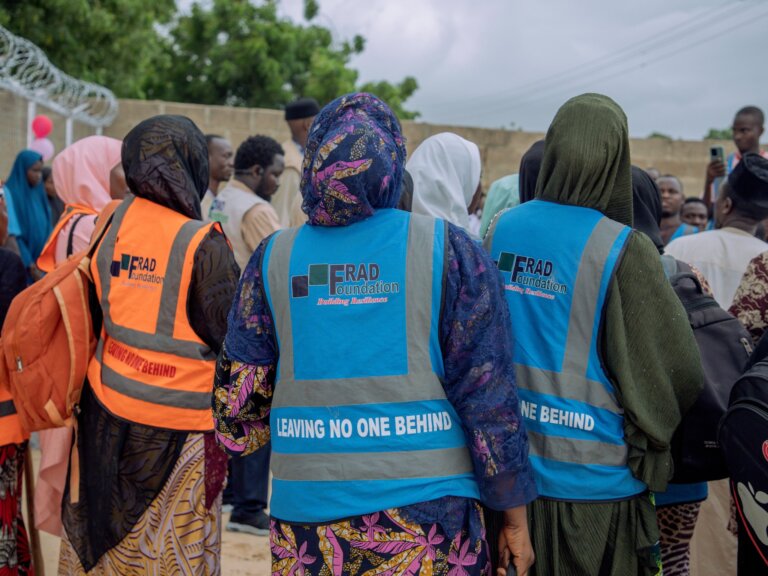
Wabba explained that the foundation responds to malnutrition in two ways: prevention and the actual response. The preventive approach entails multiple awareness sessions and nutrition education in local communities where caregivers are sensitised on basic nutritional needs and the importance of exclusive breastfeeding. This approach helps to promote early detection, referral, and treatment of malnourished children.
For the actual response, Wabba explained that the foundation engages in ‘active case finding’ by going house-to-house to screen children aged 6 to 59 months for SAM, using community nutrition mobilisers trained to identify malnourished children in communities. The foundation has 50 community nutrition mobilisers selected from five of 27 local government areas where they work in Borno state. Some of the visible symptoms mobilisers look out for include whether the child has a swollen body, lost weight, lost appetite completely, and is too weak to suckle on their mother.
Once identified, children with SAM and medical complications – such as infection – are referred to the stabilisation centre run by the foundation while children with SAM but without medical complications are directed to the foundation’s outpatient therapeutic programme (OTP).
Once they arrive at the stabilisation centre, Lawan Kaigama, Chieyine Nelson, and Khalid Shettima, the medical doctors heading the centre, explained that the children are first taken to the waiting area to receive glucose water. ‘This is to prevent children from dying from hypoglycemia, that is low blood glucose [or sugar],’ Kaigama told FairPlanet in a Google Meet call, adding that the glucose water is particularly important for children whose blood glucose may have dipped as a result of the long-distance journey from their community to the centre.
Just before they are admitted for treatment, children’s vital signs, such as body temperature, breathing rate, and pulse rate, are taken to ascertain how well their body’s most basic functions are working. Part of the treatment at the centre involves feeding malnourished children with either F75 or F100 – therapeutic milk formulas used to treat malnourished children in the acute or critical phase.
‘The aim of this [formula] is to ensure that we stabilise their systems which have deteriorated and are starved of good nutritional food, and boost their capacities to be able to tolerate normal feeds,’ Kaigama told FairPlanet in a Google Meet call. During this period which typically lasts seven days and sometimes up to 14 days depending on the severity, Kaigama said that caregivers are fed three times daily.
‘My child’s body is looking finer and better and no longer wasted [low weight for a child’s height],’ Bintu, who watched her son recover during his seven-day treatment, said. In fact, of the 201 SAM children admitted since August 2025, Bintu’s child is among the 183 children that have been treated and discharged. ‘So far, we have not had any child who relapsed into severe acute malnutrition,’ Kaigama said.
After treatment, children discharged from the centre are transferred to the OTP. Here, caregivers are again sensitised on exclusive breastfeeding and nutritious meal preparation. Additionally, they are given basic routine medications that address the immediate health needs of children, as well as Ready-to-Use Therapeutic Food (RUTF), a nutrient-dense paste made from peanut paste, vegetable oils, sugar, iron, as well as vitamins and minerals. RUTF does not require cooking; children are expected to consume two sachets of RUTF daily for eight weeks to support their recovery.
In addition to the therapeutic food, the foundation gives caregivers whose children received treatment at the stabilisation centre cash of $70 (€60.56) to help them buy nutritious food for their homes. Kubili Kami, who coordinates the cash transfers, said that the foundation has a team that does post-distribution monitoring bi-weekly to ensure caregivers use the money for what is meant and to examine the wellbeing of children.
‘The cash is to support them as we don’t want them to fall back after treatment. To control malnutrition, the cash helps to support these patients with the necessary items they need after treatment,’ Kami told FairPlanet in a Google Meet call.
Fanna Mohammed said the foundation’s intervention saved the life of Hadiza, her 24-month-old daughter, who was treated for malnutrition, as well as other complications such as a swollen leg, frequent vomiting, and diarrhoea. The cash intervention, Fanna added, helped improve their quality of food.
‘The situation before the intervention was overwhelming. My child was sick and there was no money for basic needs or food,’ the 35-year-old mother of eight told FairPlanet in her local Kanuri language. ‘But I feel happy and grateful for my child’s free treatment and the money the foundation gave us. The money lessened the financial burden on my family.’
And as part of its effort to promote water, sanitation, and hygiene, the foundation gives caregivers a hygiene kit when their children are discharged. The kit contains soap, detergent, buckets for domestic activities, and chlorine to purify and disinfect their water at home.
Fatima Ali believed the kit came at the right time. ‘The hygiene kit helps me to clean dirty linens and utensils,’ said Fatima, whose youngest son Umar, received free treatment at the stabilisation centre in June.
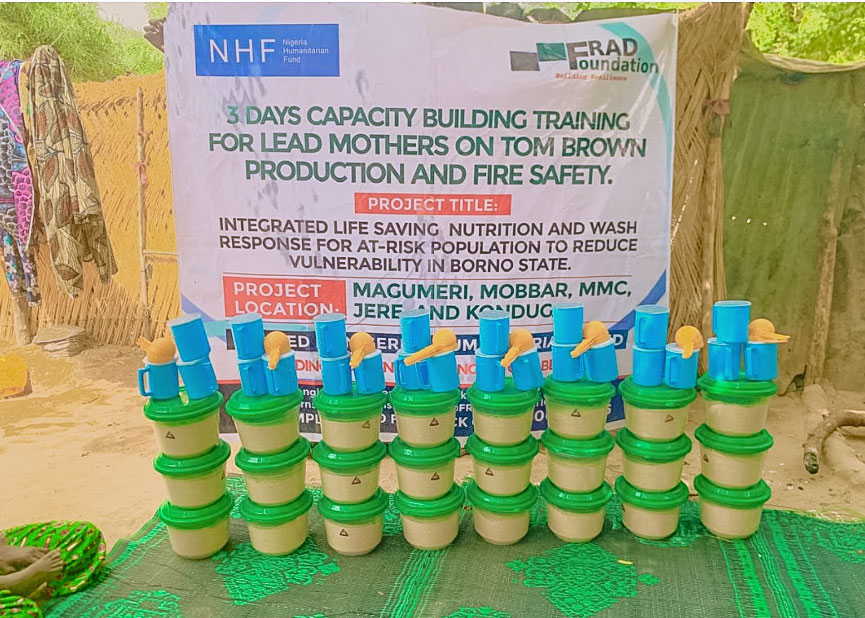
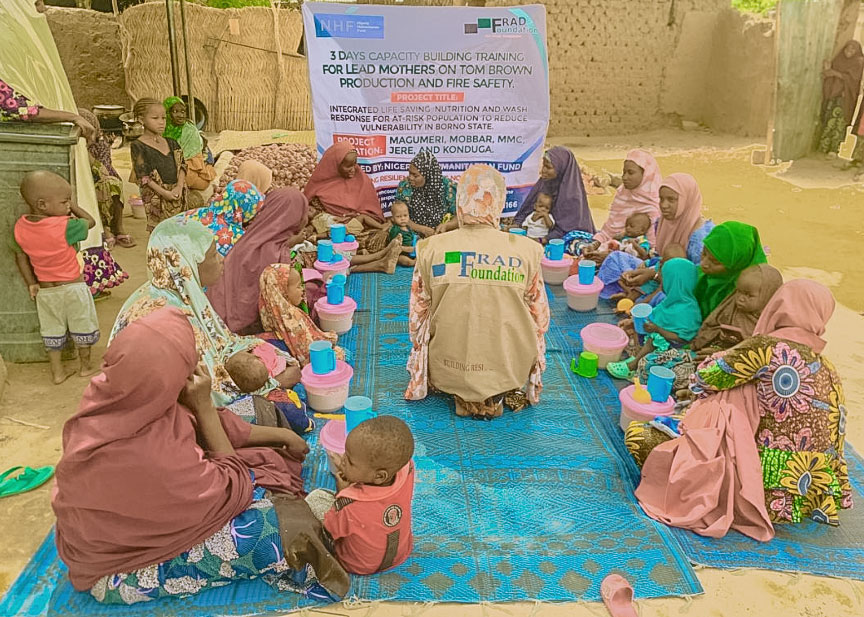
To treat moderate acute malnutrition in children and ensure they do not suffer severe acute malnutrition, the foundation introduced the Tom Brown – nutritious cereal common in West African countries – initiative. This initiative involves training a few women selected from different communities how to make Tom Brown. These women, in turn, go back to their communities to train other women over a period of eight weeks.
Benjamin Alex, FRAD’s multi-sectoral project manager, said the foundation provides the women with resources and locally sourced ingredients such as soya bean, millet, sorghum, and groundnut. After it is prepared, each caregiver receives a portion, enough to sustain each child for at least two weeks.
Already, 1,500 caregivers have been trained and received Tom Brown, Alex said. He added that the foundation has launched the second phase of the initiative which, like the first, will also target 1,500 caregivers.
‘Our goal is to save the lives of children,’ Alex told FairPlanet in a Google Meet call. ‘We identify the contributing factors that made them malnourished in the first place then we address them.’
While the supply of RUTF by UNICEF and donations that support the Tom Brown initiative help the foundation fight malnutrition in Nigeria, Alex said escalating security challenges in some parts of Borno state, particularly abduction and attacks on churches, mosques, schools, police stations, and government buildings initiated by the terrorist group Boko Haram, resulting in thousands of deaths and millions of people being displaced; plus operational challenges such as accessing and transporting RUTF to hard-to-reach areas, limit the foundation’s work.
In the meantime, Bintu said her child has fully recovered and that the new changes in her son are a huge relief. With the work of FRAD, children like Bintu’s son will have a chance to eat nutritious food and live a healthy life.
‘He eats well now and has really gained weight,’ Bintu said. ‘The complications I complained of have also been resolved.’
Image Credits: FRAD Foundation