- About
- Topics
- Story
- Magazine
- In-Depth
- Opinion
- News
- Donate
- Signup for our newsletterOur Editors' Best Picks......Send
Read, Debate: Engage.
Yehor Konovalov was sitting in the car he just borrowed from his mom when all hell broke loose . ‘Everything started to explode around us`, Yehor remembered. He was on the road in eastern Ukraine driving foreign journalists. And suddenly he found himself in the middle of the war. His team had just watched Ukrainian artillery fire at Russian positions and did not expect such a fast answer.
Russia’s full-scale invasion had gripped Ukraine for months when a friend asked the 23-year-old Yehor for help on a job: ‘driving journalists around, translating a bit,’ he remembered the job description. Yehor speaks fluent English and could borrow his mother’s car, so he agreed.
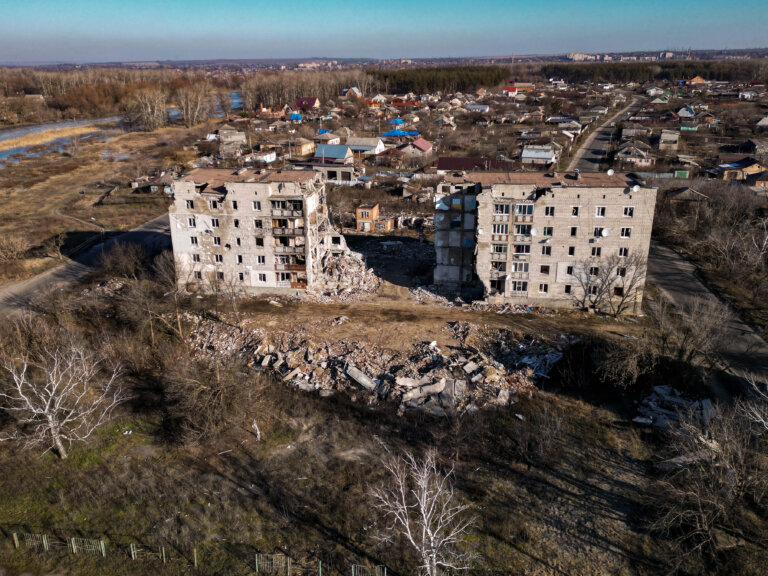
Destroyed Building in Izium, Ukraine
‘I just stumbled upon it,’ he said of his entry into the new profession in an interview with FairPlanet. Six months into the war he had been looking for purposeful work. “I just wanted to feel that my job meant something,” he said. His first day as a so-called fixer he described as pure hell.
But he made it out alive – luck not every media worker in Ukraine has had. At least 16 journalists and media workers have been killed while reporting in Ukraine since early 2022, Reporters Without Borders (RSF) reports; the Committee to Protect Journalists lists 21. At least 62 have been injured and 26 Ukrainian journalists are in Russian custody. Russia has repeatedly been accused of deliberately targeting journalists: by February 2026 RSF had documented more than 175 cases of abuse and filed ten war crimes complaints with the ICC and Ukraine’s Prosecutor General.
Ollie Shore knows these risks well. The 37-year-old began working with foreign media in Ukraine in 2014, and like many local media workers she is often described as a fixer – a loosely defined term.Ollie believes the label understates the work: ‘A local producer has more responsibilities. They are part of the team,’ she told FairPlanet. ‘A fixer sometimes is more like an assistant.’
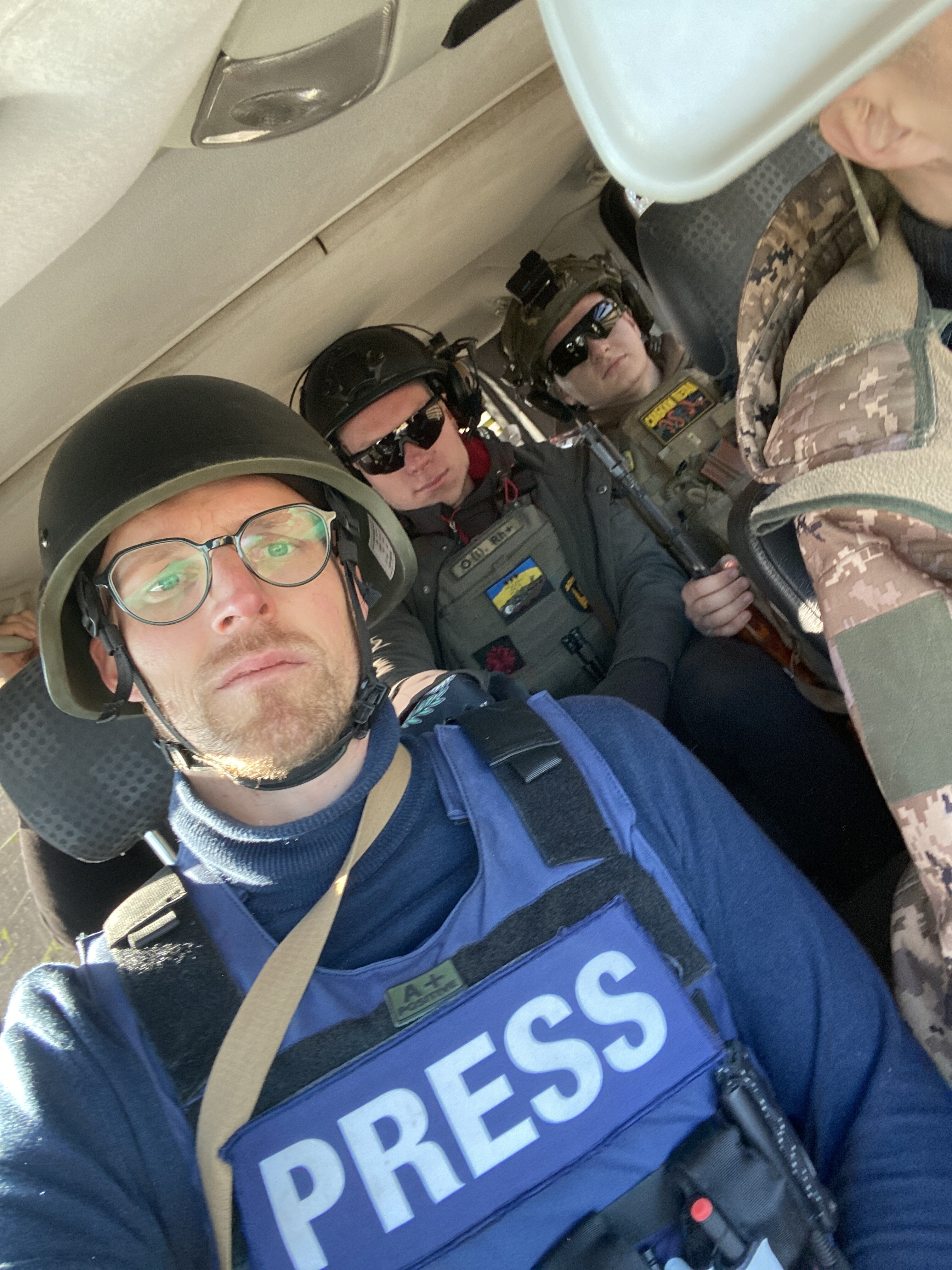
Author Fabian Janssen (Front left) with fixer Yehor Konovalov (back left) reporting from Ukraine
Many fixers start with no journalistic experience but bring organisational skills, languages and wide networks. Yehor had to learn journalistic standards, filmmaking, security protocols and frontline restrictions not by training, but simply by doing. ‘It was all about not being afraid to make mistakes.’
The job as a fixer demands constant improvisation. ‘This job is sometimes really underestimated’, Ollie said, but worse for her is that ‘in some countries being a fixer and local producer is not even considered a real job.’
Like Yehor, Ollie never planned this career. In 2014 she was a stylist’s assistant when the drastic developments of the Maidan revolution brought more and more foreign media to Ukraine, and the demand for local guides rose while there were only a few professionals. A friend told her about fixing – a word Ollie said she had never heard before. Weeks later she was working for a German newspaper and a large American press association, proud to be helping, and ‘making sure we are seen,’ she said.

Field producer Ollie Shore
Both stories carry a tragic irony: neither Yehor nor Ollie would do this work without the upheaval of war and authoritarian repression. A crisis pulls in hundreds of foreign journalists at once, far more than there are trained local professionals, and demand surges exponentially wherever crises erupt. Ollie is straightforward: ‘This job is basically created by bad things’.
Ollie’s first frontline experience was with a French TV team near the Kreminna forest. ‘It was absolute hell on earth’, she said. They had just left the position where they filmed Ukrainian soldiers when a Russian attack hit the trenches. ‘One minute later, and we would just have been there,’ she said.
Yehor told FairPlanet about a close call as well, he remembered a job where the only vehicle available to him was a red car. He drove it in a convoy with two white buses into the city of Vuhledar under a cloudless sky, when Russian shells exploded only metres away. Arriving at the shelter, he remembered civilians asking him which road they had taken. ‘Are you suicidal?’, one said to him, Yehor remembered – they had used the wrong, dangerous one. The dangers for fixers are a mix: missing experience, pushy foreign media teams, and the unpredictability of war.
Both Yehor and Ollie calm themselves the same way, as they told FairPlanet independently: the soldiers are there every day, and some make it out alive nevertheless. ‘Who’s going to survive is a roulette’, Ollie said. ‘I just think that they can’t kill everyone. So, I hope that it’s not me today.’
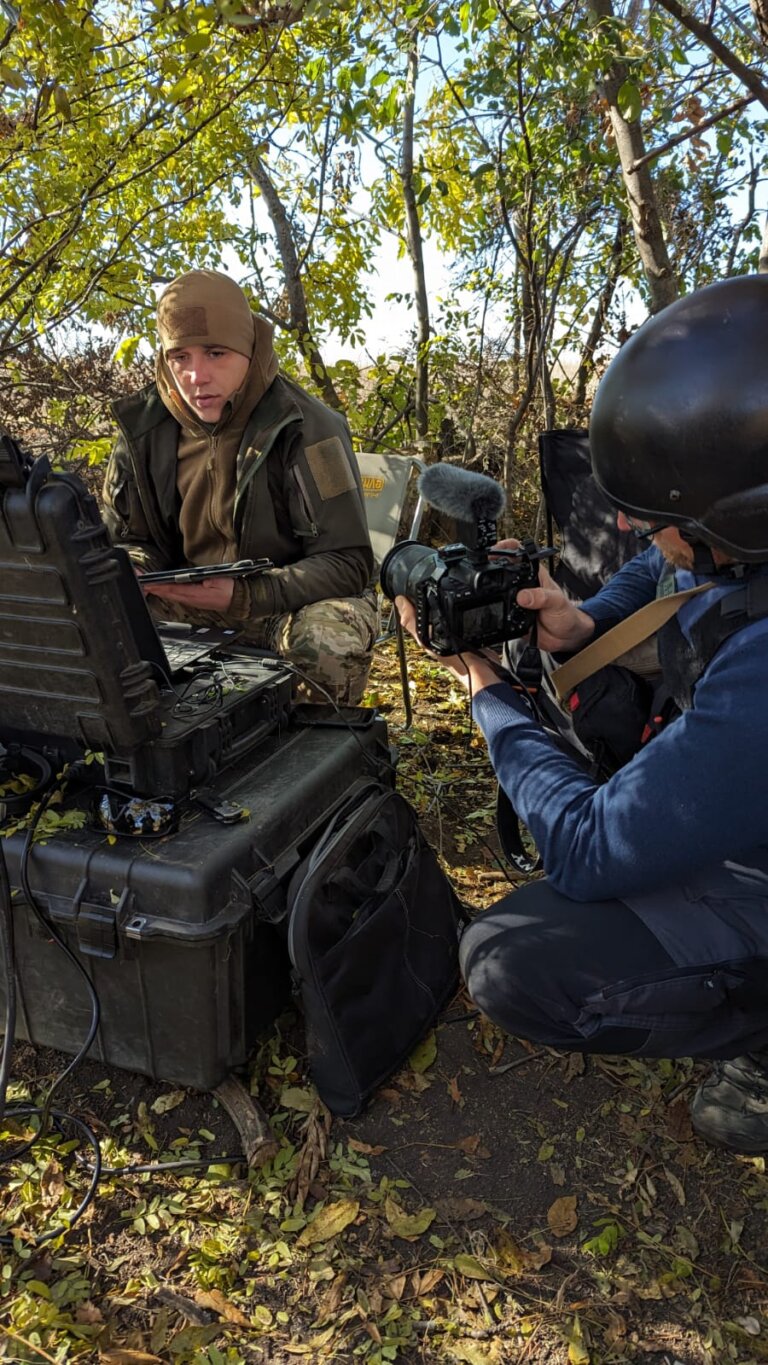
Media Work at the Frontline
For most international journalists, their time of reporting in Ukraine and within the dangers of war is limited to a few days or weeks. After that they go back home. But once one foreign team leaves, the next arrives, and the local fixers stay and continue to be in danger. ‘I don´t feel left behind. I know the perspective of a lot of journalists are, that they leave us behind in the struggle. I´m not thinking about that. When we drive back to Kyiv for example, I think about leaving the soldiers at the frontlines behind in their fights and struggles for Ukraine,’ Yehor said, thankful for the journalists who are telling Ukraine’s stories.
Physical danger is not the only difficulty. Sometimes the work means helping with stories about corruption, for example in critical sectors such as defence or energy, on human rights violations, or increasingly violent mobilization methods – topics many Ukrainians fear could damage their country’s image when it needs foreign support.
‘We have problems and those are inside problems mostly’, Ollie said. ‘Every nation does.’ But nevertheless, such topics create internal conflicts for Ukrainian fixers, as Ollie explained: ‘‘I have to stay objective and drop my subjectivity. I’m Ukrainian, but I’m also a professional journalist and producer, so sometimes I have to separate those two parts of myself.’
Yehor knows this balancing act very well too, he says. ‘You have to balance it constantly and you have to understand that it cannot be all bright and white. It’s also not just black and white. It's always somewhere in the middle and to distinguish these colors is important in this job. If you are thinking just black and white your worldview will collapse fast.’ Pointing out issues about Ukraine is an investment in the country’s future, Yehor explained. ‘It's the reality of the war that also such topics happen and it's important to highlight what might go wrong in the army. So it might not happen again in the future. Even if it's not pleasant to speak about it.’
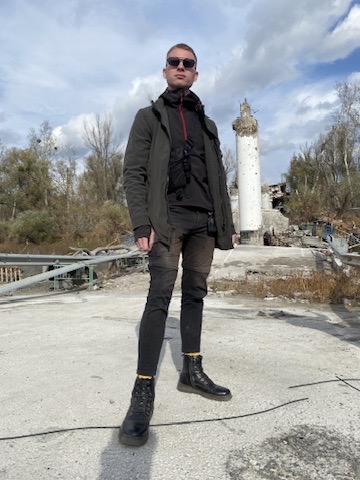
Fixer Yehor Konovalov
But sometimes stepping in as a Ukrainian is less about loyalty to the country and rather empathy to their people. Ollie said that she once stopped an interview when a foreign journalist kept pushing a crying woman about prisoners of war. Some international teams chase fast stories that can make headlines and forget along the way that they are dealing with people living through their worst moments. For that reason she said, she no longer works with yellow press journalists – reporters from outlets that prioritise attention-grabbing stories over careful and responsible reporting.
‘We are all traumatized. All Ukrainians are traumatized’, Ollie said. She travels abroad every two or three months so the war does not become too normal to her. As a man, Yehor cannot leave. ‘Parties, bright lights, crowds, I cannot deal with that anymore,’ he said, continuing to explain that he already visited a psychologist to cope with the trauma. The worst part, he said, is ‘putting your friends in the ground.’
Some fixers stay in that line of business for years, or become journalists for Ukrainian media outlets. Besides still working as a fixer, Ollie also works as a producer and journalist, covering stories away from the frontlines. And she has a big dream: ‘I would like it if a film from a job did get an Oscar’, she said, laughing.
Yehor also started working more journalistically. But at the end of 2025, after three years full-time on the front line, he stopped working as a fixer and moved into corporate communications.The job left its marks, but he nevertheless looks back on it positively: ‘I would not change a thing’, he said. ‘Many people didn’t have this lucky chance.’ Local fixers are often torn between involvement in a suffering country and the profession they are building. ‘I just hope that in the future all this knowledge and all this suffering that we’ve been through will not be for nothing’.
Image Credits: Fabian Janssen