- About
- Topics
- Story
- Magazine
- In-Depth
- Opinion
- News
- Donate
- Signup for our newsletterOur Editors' Best Picks......Send
Read, Debate: Engage.
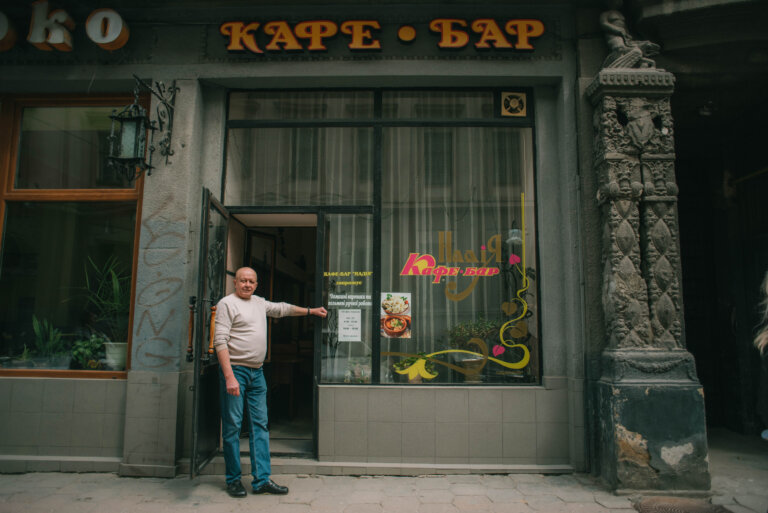
Many people walk right past the unassuming Café Nadiya, located directly across from the Lviv post office – but those in the know push open the two barred doors to find themselves in Igor’s small restaurant.
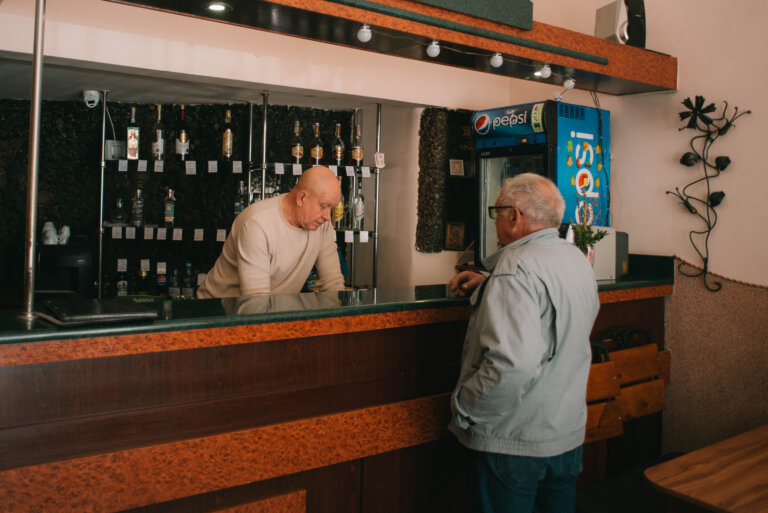
The room contains a few small tables, around which various guests sit. Igor stands behind the bar, keeping an eye on everything. Behind him is a well-stocked collection of Ukrainian cognac and vodka bottles. Next to a Pepsi fridge stands a Ukrainian flag. On the wall hangs a photo of the city of Budapest that Igor’s wife took. At the time of our visit, Igor had planned to take it down because of Viktor Orbán's policies. Since then, Orbán has been voted out of office.
Everything seems to be frozen in time. Many sips have been taken from the glasses at Café Nadiya, and many bowls of borscht have been eaten from its plates. The tables and chairs probably date back to the last century. Igor opened this small bistro in 2001 and serves authentic Ukrainian home-style cooking. Among the many dishes on the menu are kanapka, vareniki, salo and his favourite dish, pelmeni.
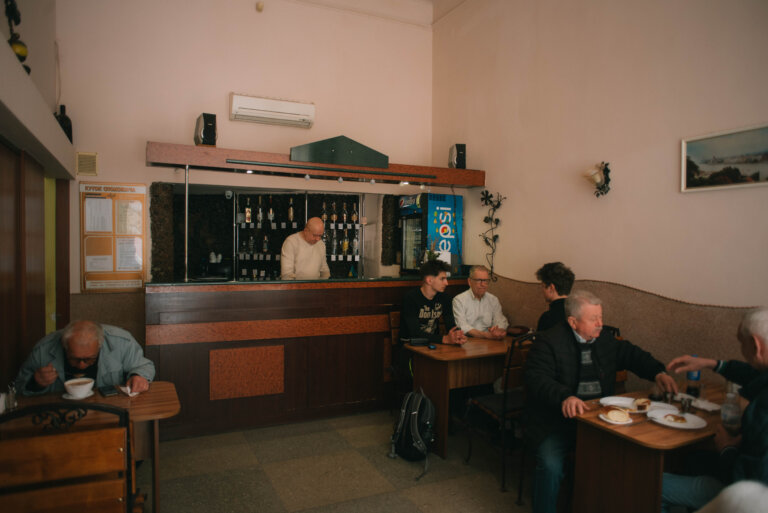
‘We don’t have a single dish that everyone loves,’ Igor says, ‘but among the most popular dishes are vareniki and our deruny’ – Ukrainian potato pancakes that taste best with smetana, something like Ukrainian sour cream. It’s important to Igor that everyone feels comfortable here, which is why he believes: ‘Everyone has their own taste and should eat what they like best.’
Igor is 65 years old and has calm blue eyes. He smiles and laughs a lot as he happily talks in his deep voice about himself, his guests, and Lviv. He has a chain tattooed on his left arm: ‘It used to say “Lvov” there,’ he explains, referring to the Russian spelling of his hometown. He had the city’s name tattooed during his time in the Soviet Army. Today, he no longer wants to give his city a Russian name. Lviv, with an ‘i’ instead of an ‘o’ – that’s important to him – because here, we are in Ukraine.
Even though Lviv, in the west of the country, is far from the frontlines, the war is felt everywhere. This is true even at Café Nadiya – or perhaps especially here. A study by Gradus Research shows how Ukrainians’ relationship with food has changed during the war. The main factors driving this change have been rising food prices, stress, and the frequent attacks from Russia.
More than half, 57 per cent, of respondents in Ukraine (excluding the occupied territories) reported that their eating habits have changed due to the war. A major factor in this was the lack of sleep caused by nighttime drone attacks. In addition, about three-quarters of respondents are trying to cut down on food costs and are cutting back primarily on sweets and snacks. The focus today is more on food that fills you up and gets you through the day.
Igor has also noticed that people are cutting back at Café Nadiya. Far fewer people are coming into his restaurant. Igor also adjusted his opening hours because there are fewer people out and about in the evenings. They’re now only open until 7 p.m., not until 11 p.m. like they used to. ‘So much is happening out there right now,’ Igor says, ‘a regular customer comes in almost every day – unless he’s on holiday, maybe.’ For many people here, Café Nadiya is a place where they feel at home and can take a brief break.
But the prices are also a topic of conversation among Igor’s customers. ‘There are people who come in here and ask, “Why are you so cheap?” but just as many who say, “Why are you so expensive?”’ Igor wonders. The prices on the menu are very reasonable by Lviv standards. ‘Here, you can get a full lunch for a good price; in other restaurants, you get almost nothing for that,’ Igor adds.
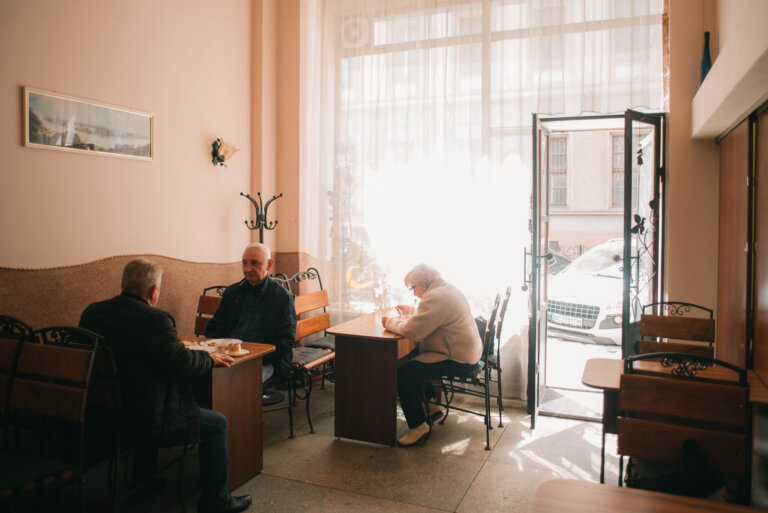
The crowd here is very diverse. Igor is convinced that most people come for the cosy atmosphere and the good food. ‘Professors from Lviv University enjoy eating here just as much as someone who lives on the street.’
He is particularly proud of a song written by the Ukrainian singer Palindrom. Igor pulls out his phone and plays the song on YouTube. ‘You are my love, you warm my soul,’ Palindrom sings about Café Nadiya. It’s a place for everyone.
All sorts of people gather around the tables: retirees, soldiers, journalists. Those who are just passing through meet regular guests who have family members in the military or have fought themselves. Some have even lost loved ones in Russia’s war against Ukraine. Igor is one of them.
‘We had a regular customer who, sadly, died – at the age of 50. He fought in the war,’ says Igor, visibly moved. He shows a photo from the funeral. Men in camouflage stand in a row, holding a Ukrainian flag. ‘His son comes by regularly now, and we often go to church with him. My customers have really grown close to my heart.’
And it seems to be just the same the other way around. Valentin is sitting at one of the tables, eating a plate of vareniki. He’s wearing a dark green sweater with a small Ukrainian flag on the shoulder. He’s been coming here regularly for 25 years. His school was right around the corner. ‘Café Nadiya hasn’t changed much since I was a kid,’ he remarks.
In 2022, at the start of Russia’s full-scale invasion, he was drafted into the Ukrainian army. He served for over a year and a half until he was wounded by a landmine near Donetsk – in the fiercely contested city of Bakhmut.
He recalls that, out there on the frontlines, it didn’t really matter how the food tasted. It had to be prepared quickly and provide the fighters with enough calories. That was all that mattered. On the front lines, Ukrainian soldiers sometimes have to endure days without enough sleep and cover distances of several kilometres on foot. Therefore, rations are designed to provide up to 5,000 calories a day.
Here at Café Nadiya, Valentin loves to order his favourite dish: vareniki. ‘It tastes almost just like my grandmother used to make,’ he says. ‘She used to cook them every Sunday.’ Like Valentin, most Ukrainians probably have one or even two grandmothers who are very keen to make sure everyone in the family has enough to eat. And above all, they love to offer seconds, even when you’re already full. This is probably one of the consequences of the Holodomor you can still feel today.
The Holodomor, a man-made famine imposed by the Soviet regime in 1932–33, killed around four million people, with a further half-million estimated indirect losses through lost births. More than 30 countries, as well as the European Parliament, recognise the Soviet regime’s deliberate starvation of Ukraine as genocide. Accounts from survivors’ families describe an enduring reluctance to waste food, the careful preservation of bread and the importance attached to feeding younger relatives.
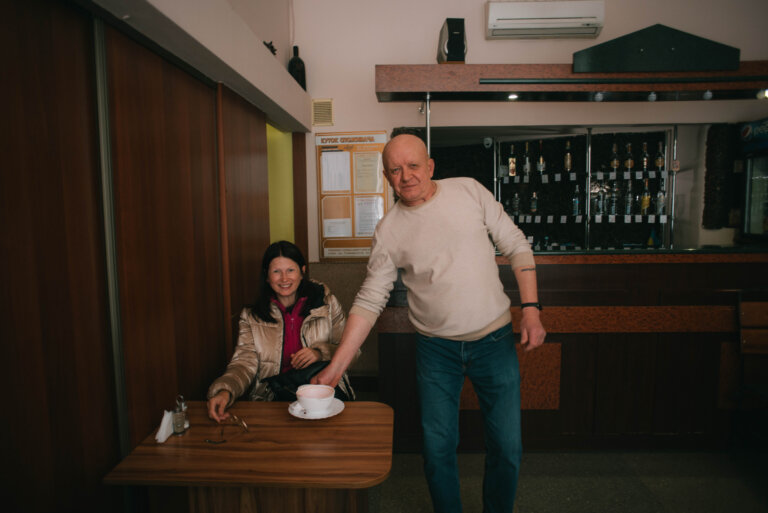
‘When people are hungry, they’re usually in a bad mood. But once they eat something, they’re in a good mood again.’ Igor knows this from his own experience. ‘That’s why I believe that eating well helps, even during the war.’ But he refuses to believe that the Russian war against Ukraine could permanently change anything about Ukrainians’ eating habits. ‘This isn’t our first war. And anyone who loved vareniki before will still love them afterwards.’
At Café Nadiya, there’s a sense that everything will somehow work out. The café’s name comes from Igor’s mother, ‘Nadezhda.’ But it also has another meaning: ‘Nadiya isn’t just a name; in Ukrainian, it also means hope.’ And today, Igor hopes that the war will end soon, that all his guests will return safely, and that he’ll be able to serve them the dish that makes them happy again.
Image Credits: Jevgenia Trenchuk
(This is the first instalment in a three-week FairPlanet series on how Russia's war has reshaped daily life in Ukraine, with a new piece published each week. Keep checking this space for more)