- About
- Topics
- Story
- Magazine
- In-Depth
- Opinion
- News
- Donate
- Signup for our newsletterOur Editors' Best Picks......Send
Read, Debate: Engage.
Nadia can see burning candles from the fifth-floor window of her student dormitory in Lviv, Ukraine, every night. The flickering light shines from the Mars Field, the part of Lychakiv Cemetery where the city buries soldiers killed in Russia’s war against Ukraine. The cemetery is the first thing Nadia sees when she walks home or leaves in the morning. She has lived with that view since she moved to Lviv in autumn 2024. ‘Due to all my attempts to escape from war, I’m here, living just near the huge reminder of it,’ Nadia said.
Nadia is a first-year student at the Faculty of Journalism at the Ivan Franko National University of Lviv. Originally, she is from Odessa, one of Ukraine’s war-torn cities in the southwest. She went 800 kilometres across Ukraine to a place that was ‘the furthest away from Odessa. I was sick of the explosions,’ she said.
Lviv is a hotspot for internally displaced Ukrainians, including many students like Nadia. It’s a generation learning to live in a duality, as the 18-year-old Nadia said: ‘Life and war and war and life. The most important thing is that life continues.’
Since the start of Russia’s full-scale invasion in 2022, studying and teaching in Ukraine have been characterised by constant disruption, insecurity, and structural challenges, as recent research indicates.
The extent of damage to Ukraine's education and science sectors is staggering: According to the Fifth Rapid Damage and Needs Assessment (RDNA5), the estimated cost of damage stands at US$13.9 billion. Although destruction is concentrated in the East, the consequences of the war on education reach across the country.
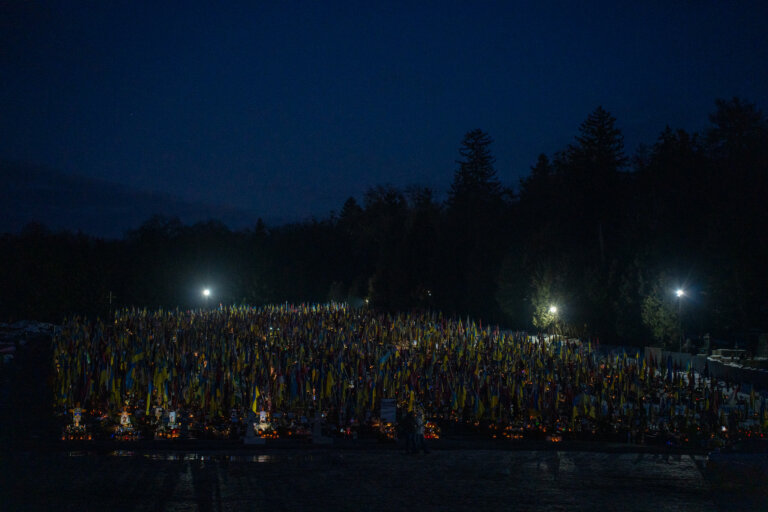
Flickering Lights of the Mars Field at night
In Lviv, Russian missile and drone attacks are not as constant as further east. Nevertheless, academic life is marked by regular power outages and frequent air raid alerts that interrupt classes, force evacuations to bomb shelters, and increase anxiety, as described in a 2025 study.
Nadia said that in Odessa she had a life almost fully defined by Russian attacks. ‘You have explosions every minute for like one hour, and you are getting used to it.’ The sleep deprivation and constant noises of drones and explosions are the most devastating, she said.
In Lviv, there aren't any attacks every single night. But some things won’t change for Nadia: ‘I have this thing where I’m paralysed when something happens, like an explosion or the air alarm sound,’ she said. ‘I just lay, and I cannot move.’
What’s new for her in Lviv is that it’s quite common to talk about the war. ‘In Odessa, we don’t speak a lot about war just because we hear it a lot,’ she said. ‘But here, people don’t hear war as much, and because of that they speak a lot about it.’
Iryna Protsyk, a lecturer at the Faculty of Journalism, is quite familiar with the difficulties students face. She only started teaching after the full-scale invasion began. Training future journalists is her ‘way to help,’ she said.
For Protsyk, understanding her students means understanding the sequence of crises that have shaped them. ‘They came to university during the pandemic,’ she said, referring to the COVID-19 pandemic, ‘then the full-scale invasion started.’ As Protsyk explained, this means that most students have not experienced adult life under non-crisis conditions: today, many have relatives or friends serving at the frontlines; others have been displaced within Ukraine; and most have experienced personal loss.
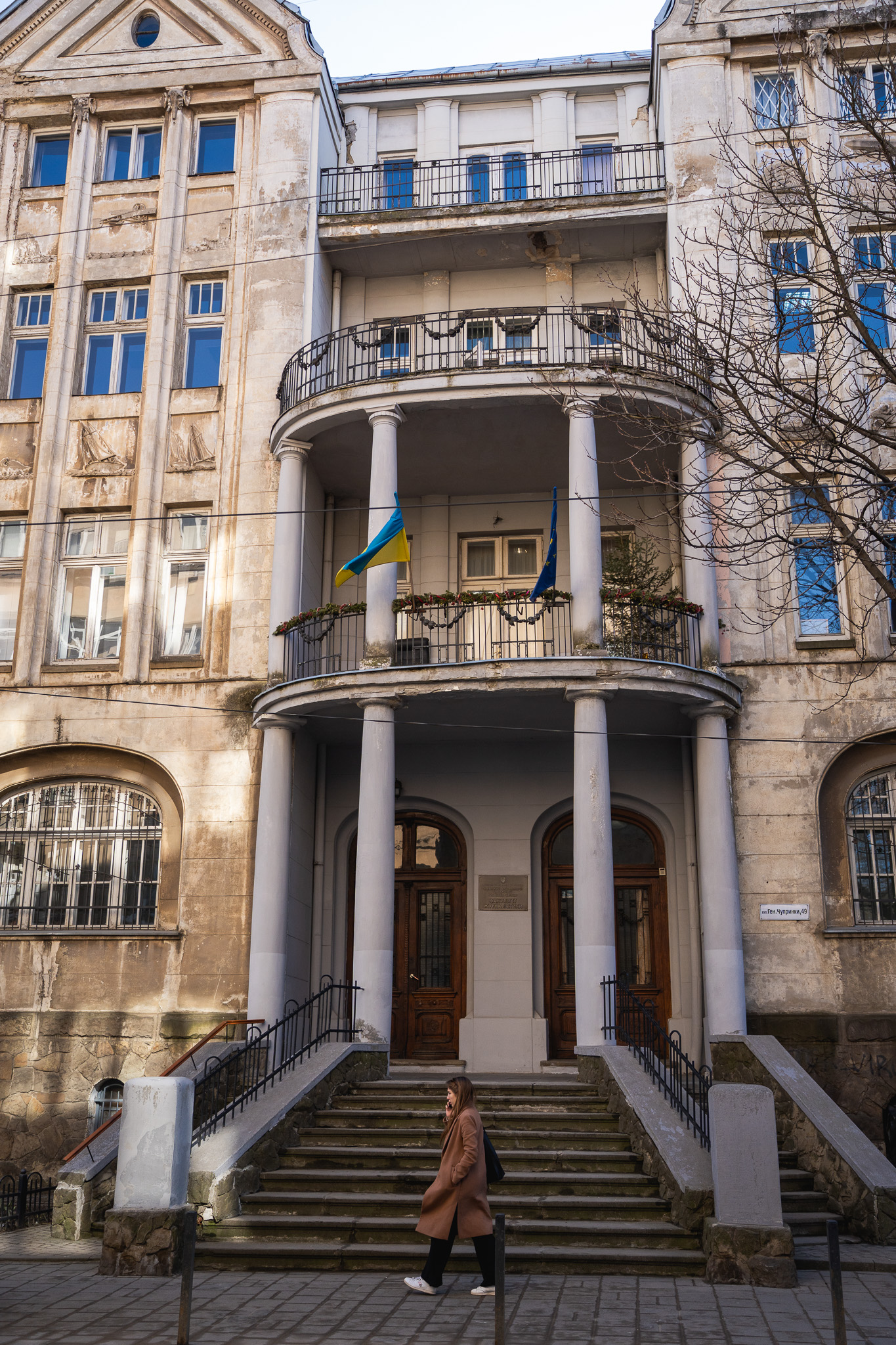
Faculty of Journalism
‘Teaching should be very careful,’ Protsyk said. Part of her role as a lecturer has become offering emotional support. Students confide in her about personal traumas. She recalls one student breaking down in class. ‘I asked her if she needed a hug, and she said yes,’ Protsyk recalled. ‘I hugged her because it was the least I could do. I did ask first, of course, but she said yes. I think it's part of our job, not as lecturers, but as humans: if someone asks for your help, you help.’
Empathy also shapes the way she evaluates students. Deadlines and attendance are handled flexibly, in recognition of the fact that many students have responsibilities beyond their studies. ‘I have a student whose father was killed in the war and whose mother fell into depression. He has a little brother he needs to support, so he has had to start working,’ Protsyk said, explaining that above all ‘we need empathy.’
The student dormitory Nadia lives in was originally the foreign student wing of the local medical university, but it has increasingly become the wing for internally displaced students. Nadia shares her space with five other young women. They share a bathroom, a kitchen and their war stories. ‘In our room,’ Nadia said, ‘we are only girls who experienced war. We have so much in common. Our deep, deep thoughts and traumas.’
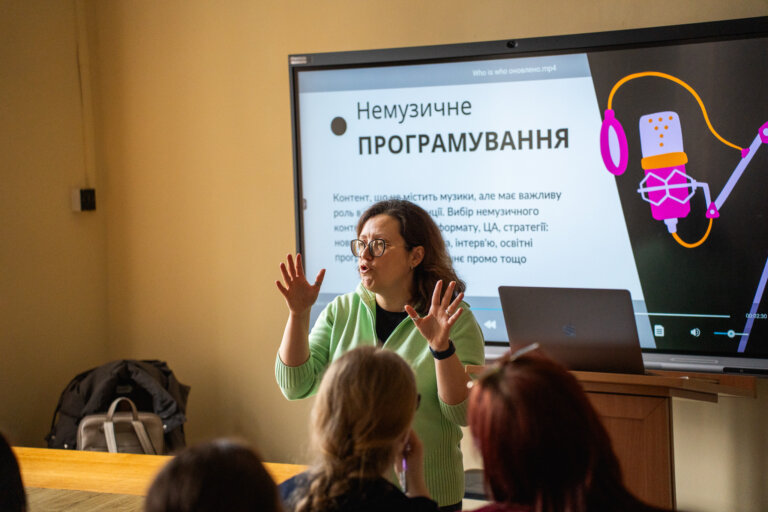
Teacher during a lecture
But their lives are not only affected by sirens and bombs. For some, war decreases the chance of a romantic relationship. ‘Her faculty has more than a hundred students, but only five of them are men,’ Nadia said. Across Ukraine, many men close to conscription age have already left or are trying to leave the country. Many who remain try to avoid being drafted. ‘Boys are hiding. It’s crazy here,’ Nadia said.
Today, Nadia is in a relationship with one of the five boys from her faculty. Asked if her boyfriend was scared, she said, ‘Maybe just a little.’ ‘Maybe just a little.’
Her friends are also some kind of replacement for her real family. ‘The war has divided my family. Now every member is alone, doing their mission,’ Nadia said.
Protsyk frequently incorporates practical work into her classes to connect her teaching closely with the realities her students are preparing to face.
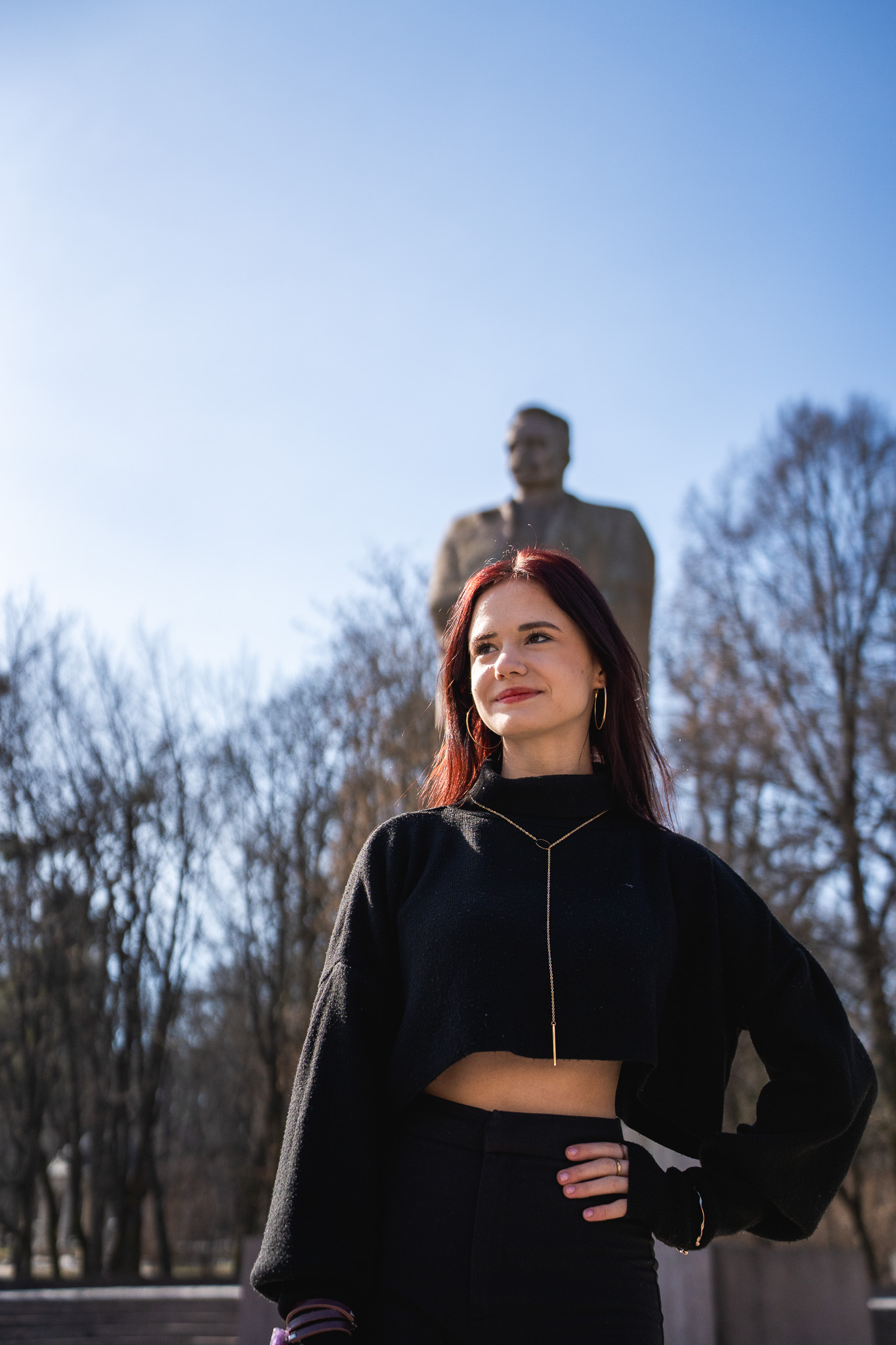
Nadia in front of Ivan Franco Statue
According to Protsyk, the war has fundamentally reshaped the meaning of both being Ukrainian journalists and teaching journalism. Questions of ethics or safety aren’t abstract concepts. ‘It is very hard to be a journalist in a country under invasion,’ she said. Students must learn how to navigate propaganda, misinformation and the realities of reporting in wartime.
Many graduates work as journalists, fixers or press officers. ‘Our students should understand that they must show the world the Russian war crimes,’ Protsyk said – a task she described as the main objective of Ukrainian journalists working in Ukraine today. ‘Maybe we will change the focus after the war, but right now, this is the main goal.’
Nadia shared that telling the stories of war keeps her going. That’s how she also wants to give something back to Ukraine, she said. She views the war as a big mission in which everyone has an individual part to play. ‘The main thing is to understand your role, your personal mission, your personal task. And do anything you can. Just don’t stop.’ ‘The most important thing is that life continues,’ she said. ‘You should live it, because it’s not endless.’
It’s a reminder that grows with every funeral on the Mars Field in front of her dormitory, she said. More funerals mean more candles. And so, the flickering lights of war crawl closer to her window every night.
Image Credits: Mattis Baziani-Körber